Packed to the rafters, the Indira Gandhi Indoor Stadium was witnessing history on multiple fronts on Sunday.
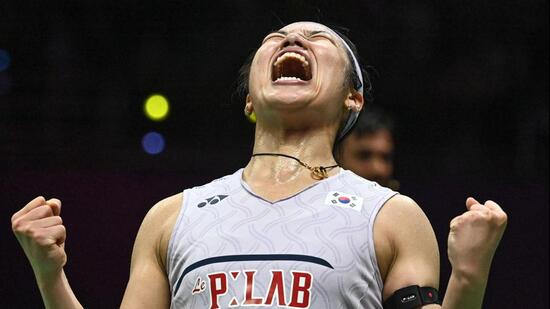
On the final day of the BWF World Championships here, badminton’s royalty reaffirmed its dominance while a rising European power jolted the sport’s global hierarchy.
At the centre of the spectacle was South Korea’s An Se Young, who captured her second women’s singles crown in a brilliant display, the Olympic champion and world No.1 defeating Japan’s defending champion Akane Yamaguchi 21-17, 21-14 in 49 minutes.
Deep Dive
How did An Se Young secure her second women's singles title at the BWF World Championships?
What does An Se Young attribute to her success during the tournament?
What achievements did France accomplish at the recent BWF World Championships?
Elsewhere, the narrative shifted dramatically as France found unprecedented success, winning the men’s singles and the mixed doubles titles.
Coming into the tournament, 24-year-old Korean sensation An boasted an otherworldly 38-1 season record, yet questions lingered over her physical condition. Taping below her right knee told a story of remarkable endurance. Her semi-final win over China’s Wang Zhi Yi had pushed An to the brink, leaving her physically drained.
Yet, true champions find another gear when the stakes are highest. Trailing in the tense moments of the opening game (16-15) against the fast Yamaguchi, An unlocked a new level of tactical clarity.
From 17-all, she rattled off four consecutive points to seize the opener. In the second game, she orchestrated a stunning sprint from 11-10, closing out the match in straight games.
{{/usCountry}}From 17-all, she rattled off four consecutive points to seize the opener. In the second game, she orchestrated a stunning sprint from 11-10, closing out the match in straight games.
{{/usCountry}}“I focused on my recovery first, and recovered very well,” said An, her grin masking the exhaustion. “Today’s match was about fighting. The simple things are very important. This is the winning reason.”
For all her tactical genius – impeccable court coverage and impenetrable defence – her motivation remains grounded in the people around her. As the crowd chanted her name, proving her status as a fan favourite, An was quick to deflect the praise to her support system.
The foundation of An’s success is a meticulously managed partnership with the famous head coach Park Joo-bong, the 1992 Barcelona Olympics and five-time doubles world champion. Her support staff had heavily debated whether she should even take the court here due to her physical struggles.
“In July, An was worried about the World Championships, whether she can play or not,” Park said. “We stopped training for three weeks for recovery. We tried to skip this tournament, but she very strongly wanted to play. We discussed it, it’s her choice and I support it.”
Park’s tactical preparation paid dividends. Anticipating Yamaguchi’s blistering pace, the Korean camp analysed the Japanese’s attacking game. “She knows how to play. Her control is very good, so is her defence,” Park said.
Beneath the tactical praise lay the challenge of managing a generational talent’s ambition. “Even with the same tournament load, she has many matches. We worry about this injury... but still, she wants to play, so we have to take care of her body condition in the future.”
An’s victory wasn’t the only gold for South Korea. Baek Ha Na and Lee So Hee ended a 31-year drought in women’s doubles, upsetting Chinese top seeds Liu Sheng Shu and Tan Ning. Lee, at 32 years and 70 days, made history as the oldest women’s doubles champion.
French revolution
France pulled off a shattering takeover, becoming only the second European nation to win more than one gold in one edition of the Worlds.
The spark was lit by the mixed doubles duo Thom Gicquel and Delphine Delrue. The last edition’s bronze medalists upset Chinese top seeds Feng Yan She and Huang Dong Ping 22-20, 19-21, 21-15 in a 78-minute final.
That set the stage for the 21-year-old Alex Lanier in the men’s singles final. Facing Japan’s Kodai Naraoka, Lanier trailed 7-9 in the opener before unleashing a breathtaking sequence, winning 13 of the next 14 points. The world No.10 maintained his vice-like grip in the second game, stringing together seven straight points from 14-11 to secure a dominant 21-11, 21-11 victory in just 50 minutes.
“I’m not going to lie, I can definitely play one more game,” said an ecstatic Lanier, who stood out for his stroke production and tactical control. “The excitement of playing a final brings quite a lot of energy. With that speed, I showed I could play long, for like two hours.”
The young Frenchman though put it down as a national milestone. “Today was a day for French badminton. When the mixed (team) won, everyone was happy. I just thought I needed to give them a double smile and make history again.”
Lanier’s rise caps a well-crafted project by the French federation. National Technical Director Gombrowicz Cyrille pointed to a government system that begins grooming talent at U-13 level, supporting a base of 250,000 licenced members.
At the apex of that system is Lanier’s coach, Kestutis Navickas, who has moulded the rising star for five years. Navickas attributes Lanier’s golden run to a holistic training philosophy. “We try to synchronise all the elements: technical, tactical, physical, and mental,” he said.
As the lights dimmed inside the arena, the Worlds will be remembered as the week An pushed through the pain to remind the world of her peerless brilliance and the day France arrived as a global badminton power.