Thursday evening turned into an unforgettable celebration of Indian hockey as the Olympian Balbir Singh International Stadium erupted in a sea of cheers and chants.
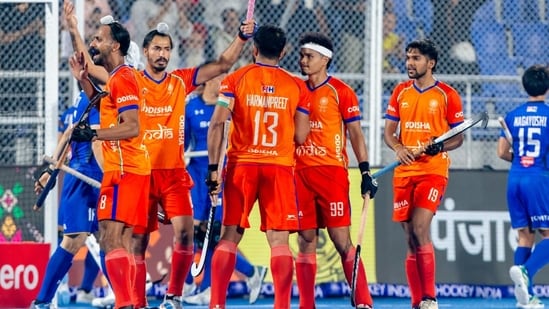
Roars of 'Chak De India!' reverberated across the jam-packed arena as the defending champions produced a stunning comeback to defeat Japan 4-1 in the final of the Asian Champions Trophy, reaffirming their supremacy in Asia.
It was a night that had everything –- an early Japanese strike, a resilient Indian response, goals, drag-flicks and a grandstand finish. As the final whistle blew, the stadium burst into jubilation, with fireworks illuminating the Mohali sky and fans celebrating another of the Indian men's hockey team.
However, the road to the title was far from straightforward. Japan came out with tremendous intensity, unsettling the hosts with their disciplined defence and aggressive approach in the opening two quarters.
Japan stunned the home crowd as early as the third minute. Matsumoto Kazumasa collected the ball on the left, drove into the Indian circle and unleashed a powerful reverse-hit that beat goalkeeper Suraj Karkera to give Japan a 1-0 lead.
India attempted to regain control through crisp midfield passing, but Japan remained compact and organised. Abhishek came close in the 10th minute, only to see his effort sail wide, while Angad Bir Singh narrowly missed connecting with a potential far-post deflection. India's early review, following an appeal for a push inside the circle, also went unsuccessful.ALSO READ: Manu, Suruchi miss out on LA Olympics quota, win team silver
The visitors continued to make life difficult for India, earning back-to-back penalty corners (PC), but the Indian defence stood its ground to prevent further damage. At the other end, Hardik Singh made a brilliant run down the right flank and squared the ball to Dilpreet Singh, only for a Japanese defender to intervene at the crucial moment.
{{/usCountry}}The visitors continued to make life difficult for India, earning back-to-back penalty corners (PC), but the Indian defence stood its ground to prevent further damage. At the other end, Hardik Singh made a brilliant run down the right flank and squared the ball to Dilpreet Singh, only for a Japanese defender to intervene at the crucial moment.
{{/usCountry}}India went into the half-time break trailing 0-1, with the pressure mounting on the hosts. Their attacking combinations had yet to produce the desired breakthrough, while Japan's defensive discipline threatened to spoil the home team's title ambitions.
India returned with renewed purpose after the interval, raising the tempo and putting the Japanese defence under sustained pressure. The hosts earned their first PC after a goal-bound Sukhjeet Singh effort was deliberately stopped by a Japanese defender. Captain Harmanpreet Singh stepped up, but goalkeeper Kisho Kuroda produced a fine save.
India continued to knock on the door. Sukhjeet's next effort was brilliantly kept out by a diving Kuroda, before Harmanpreet pounced on the rebound and sent a reverse flick crashing against the post. The equaliser was tantalisingly close.
The breakthrough finally arrived in the 42nd minute. After consecutive PCs were denied by Kuroda, India kept the attack alive. Aditya Lalage produced a superb reverse-flick pass into the danger zone, where Shilanand Lakra was perfectly positioned to convert from close range. Japan reviewed the goal for a possible dangerous pass, but the on-field decision stood. India were back on level terms at 1-1, and Mohali erupted.
With momentum firmly shifting towards the hosts, India turned up the heat in the final quarter. In the 49th minute, Hardik Singh displayed remarkable composure inside the circle, retaining possession despite intense Japanese pressure. After his initial pass was blocked, he recovered the ball and found Dilpreet Singh, who took a touch before executing a brilliant finish with his back to goal.
India had turned the match around, taking a 2-1 lead. The celebrations were barely settling when Jugraj Singh delivered another moment of magic. Following a midfield interception by Vivek Sagar Prasad and a PC won after Sukhjeet forced a foot from a Japanese defender, Jugraj stepped up in the 53rd minute. His thunderous drag-flick flew past the goalkeeper, leaving even the Japanese line defender ducking to avoid its sheer power.
India were now 3-1 ahead, and the title was within touching distance.
The fourth goal provided the perfect finishing touch to India's commanding performance. Nilakanta Sharma won possession of a loose ball, and Shilanand's initial attempt was saved by the goalkeeper.
However, the rebound fell invitingly for Vivek, who hammered home a powerful half-volley to make it 4-1 and seal India's emphatic victory.
India's triumph was a collective statement of intent. From resolute defending and midfield control to clinical finishing in the decisive moments, the hosts demonstrated why they remain a formidable force in Asian hockey.
Japan had threatened to challenge the champions early on, but India's response was emphatic. Four goals, a spectacular turnaround and a title-winning performance later, the defending champions had once again stamped their authority on the continental stage.