Those Olympic rings. Athletes ink it to their bodies, paste it on room walls, turn it into mobile wallpapers.
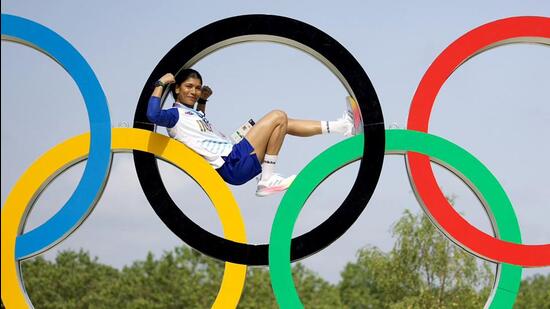
Nikhat Zareen sees flashes of it. When, pushing every ounce of the physical limit her body can take during each training session, she at times chokes up. Then comes that twinkling thought, the split-second sighting of those five rings.
“I tell myself, ‘Chal Nikhat, Olympic gold jeetna hai’.”
The boxer springs back to life and into the ring, pushed by that one sentence which not only is a single-minded self-driving tool but expectations of millions from the outside. That’s almost uncharted place to be in for an Indian Olympic debutant, no matter Nikhat’s status of a two-time world champion. She’s been handed a tough draw in Paris, and Nikhat admits that’s where luck comes in. Yet, she adds, if a medal “is written in my stars, no one can snatch that away from me”.
In this chat with HT, the 50kg boxer talks about dealing with people’s weighty expectations while giving her first Olympics as ferocious a crack as her punches.
Excerpts:
{{/usCountry}}Excerpts:
{{/usCountry}}What were some of your early Olympic memories, and did it become almost an obsession over the years?
When I started out in athletics, my only goal was to play in the Nationals. Because athletics was so tough. Especially in the south (of India) and in my state, which was wasn’t divided back then, winning a state medal also was a big deal. I never thought that I would go to the Olympics one day.
That was also the case when I came into boxing. I had one dream: to represent India. The day I became the junior world champion (in 2011), that’s when I started to dream big. Then in 2012 when Mary Kom won the bronze in London, people started seeing her as a role model, and later a movie was to be made on her. That’s when I felt, yaar, kaash mujhe bhi koi aise apna role model maane, mujhe bhi success mile life mein, mein bhi famous banu (I wish people also look at me as a role model, I also get the same success and fame). That’s when, after seeing her, that dream to compete at the Olympics was born. Today, finally, after so, so many years, I am getting the chance to do that.
This is your first Olympics despite being a two-time world champion. Yet almost everyone believes that you’ll win a medal. Do you feel that too, and how do you take that pressure?
When I was starting out and no one really knew me, the pressure of living up to the expectations my family itself was so heavy. I would drill that in my mind, that I must prove it to them. Those days, my parents were not earning too much money. So, looking after my family fell on my shoulders. It meant greater responsibilities. I couldn’t take any chance, couldn’t take the risk of getting distracted. I never really thought beyond boxing. There was no Plan B in my life. Everything revolved around boxing.
Now, especially since I became a world champion, mostly every competition that I go to, I return with a medal. Ab toh aisa hai ki kisi ka medal aaye na aaye, Nikhat ka medal toh hai hi hai. Medal bhi nahi, gold. (The thinking is such now that whether or not anyone else gets a medal, Nikhat surely will. And not just any medal, gold). If it’s less than gold, it’s a disappointment. I mean, it’s a good thing that people are expecting gold from me. But boxing is a very unpredictable sport. Injuries might force you to abandon bouts, you might get a cut, split decisions don’t go your way because judges think otherwise. At the Olympics, it’s also about the luck of the draw. From my end, though, the effort is the same. I don’t want to have any regrets that if I’d slogged a little more, I would’ve done better.
But do you do anything different to deal with that kind of pressure especially for an event like the Olympics?
Before every competition, my mindset is to stay positive. I try and keep away from outside distractions and noise. I stay away from social media. I even speak to my family only once or twice over the phone in a week. I’m building a house at Jubilee Hills (in Hyderabad), so for that I speak to my father daily. Otherwise, no boxing talks with people at home. I don’t want boxing in my mind 24x7.
Speaking of distractions, there have been plenty in Indian boxing over the last year — court cases for selection, the coaching shakeup. How do you ensure it doesn’t creep into your single-minded focus?
Distractions are around, and there are plenty of them. It does cross your mind. But I have the ability to recover quickly from thinking about that. I am quick to remind myself that all these distractions are temporary. This goal that you’re chasing, that is the main thing. And it will turn your life overnight. An Olympic medal changes lives. I’ve seen the life of athletes who have won Olympic medals turn around overnight, hai na? Someone becomes a DSP; someone has a road named after them; some have stadiums and academies named after them. And it forges a dream inside young kids, that I too want to become like him or her. So, I know that an Olympic medal will change my life. That, for me, must be the most important thing. Distractions will keep coming and going away.
Boxing is a lot about the physical work that goes behind the scenes. How have you built up that physical intensity?
Endurance, speed, power...all this doesn’t come naturally. It comes after truckloads of effort in training. Some days ago, for instance, we had a conditioning session on the treadmill. For four minutes, I had to run at a speed of 14.6 (km/hr). The last one minute, the entire body tightens. That’s when you push. The day before that, we had an 18-round sparring session of one minute each. With different sparring partners, all of them boys. Imagine, in each bout, from the first round till the last, the kind of effort I had to put in. Aisa nahi ki ek round halka le liya.
Every training session, I push myself. At times, when I have to push beyond what I feel I can take at that moment, I end up crying. Yaha [pointing at her epiglottis], I feel heavy. At times, I struggle to breathe. But I tell myself, ‘Chal Nikhat, Olympic gold jeetna hai. Push’. I take a few sips of water and immediately get back to it. It’s all about the load you put in training that makes the difference in competitions.
You’ve said experience makes a difference at the Olympics. You have all the experience elsewhere but not of that. How do you compensate for it?
In 2021, I had no exposure at all. After 2022 with the kind of confidence that I’ve developed since winning the World Championships twice, more than the people, I expect the absolute best from myself. So, whatever sweat and tears had to be put it, I have. Now I just have to show what that hard work can do. I’ll try and put all the stress aside and just go out there and fight. With a free mind. With joy. Bindaas.