Even while watching ace boxer Lovlina Borgohain collect her bronze medal at the 2021 Tokyo Olympics, Chhote Lal Yadav, a coach of the Indian boxing contingent then, had a bigger target. He had immense satisfaction in guiding four of his trainees — Sakshi Chaudhary, Preeti Pawar, Jaismine Lamboria and Arundhati Choudhary — to gold medals at the recent Commonwealth Games in Glasgow.
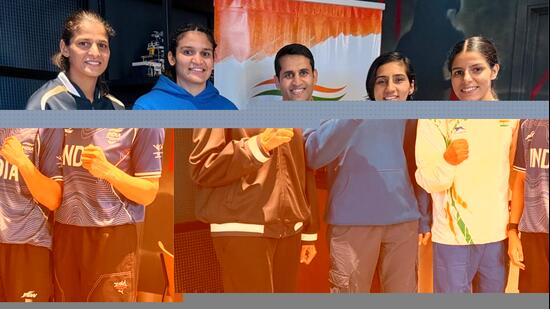
This success has inspired Yadav, who wants to help Indian boxers deliver bigger achievements at the Olympics than the bronze of Mary Kom (2012 London) and Lovlina. In all, Indian women boxers won five gold at the 2026 CWG and gold or silver at the 2028 LA Olympics will be dream fulfilled for Chhote Lal.
He acknowledges that the Olympics is an unforgiving arena, but is optimistic. The Glasgow success has supplied him with data, confidence, and vindication that Indian women can dominate if the right ingredients are there.
“Mark my word. I am determined to let my trainees change the colour of medals at LA 2028. I can now see that Indian women boxers are capable of achieving this,” Chhote Lal said on Wednesday, a day after being selected for the prestigious Dronacharya award for coaching excellence.
Chhote Lal was the personal coach of Mary Kom, India’s first woman boxer to win an Olympic medal, for seven years until 2022. He was the brain behind women being inducted in the Army, especially at the Army Sports Institute (ASI), Pune, with the support of Col Manoj Kumar.
{{/usCountry}}Chhote Lal was the personal coach of Mary Kom, India’s first woman boxer to win an Olympic medal, for seven years until 2022. He was the brain behind women being inducted in the Army, especially at the Army Sports Institute (ASI), Pune, with the support of Col Manoj Kumar.
{{/usCountry}}“Big support from Col Kumar and now one can see the results of Army’s women boxers. Four of them have won gold at the CWG and two others, Tanu and Pranjal, are getting ready for the big events,” said Chhote Lal, a Subedar in the Army attached to ASI.
Yadav’s own entry into boxing was more by chance. In 1999, scouts from Sports Authority of India and the Army visited Varanasi searching for raw athletic talent and the 11-year-old from Pahadi village stepped forward. He ran, swam and took the trials at Sigra Stadium without assuming anything about his future.
After months of physical training and tests in Pune, then coach Sahu Birajdhar, a former boxer, recognised what others hadn’t. “Your body is for boxing.” That led to a boxing career that spanned from 2000 to 2012, with medals at Asian Cadet and South Asian Games, a silver at the World Military Championships, and appearances at the 2010 Guangzhou Asian Games.
Education and excellence followed. He topped the NIS diploma course in Patiala in 2014, then joined Olympic Gold Quest as a personal coach. Between 2015 and 2022 he mentored Mary Kom and others, guiding the ace boxer to Asian gold, World Championship success and Olympic qualification.
“I never had boxing gloves in my hands before, but once I had them, I never looked back and kept throwing punches at my rivals as I knew my hard work would take me somewhere on top one day,” said Chhote Lal. “I enjoy coaching future stars.”
His confidence is rooted in both results and process. The Glasgow success was not a fluke, it came after years of meticulous planning and an effort to modernise boxing training in India.
He emphasises on holistic development, especially strength and conditioning tailored to weight categories, ring craft honed through international sparring, sports science monitoring for nutrition and recovery, and psychological conditioning to build aggression and composure under pressure.
Technique refinement is also at the heart of Chhote Lal’s blueprint. He advocates a blend of classical Indian boxing strengths — footwork, timing, counterpunching — with modern offensive systems that increase scoring opportunities.
He also highlights individualised athlete management. Recognising that each boxer has a unique physiology and psyche, he tailors training loads, recovery protocols and competition schedules to prevent burnout and injury. He’s also a vocal proponent of integrating sports psychologists into the core team.
“Winning a semi-final or final often depends on small mental margins, including belief, focus, and the ability to impose your plan under pressure,” he said.