"I don't know when the end will come for Novak, but the one thing I can say is that the end, when it does come, always comes fast." Those were Andre Agassi's words, spoken on the Amazon documentary Novak Djokovic: The Wolf in Winter.
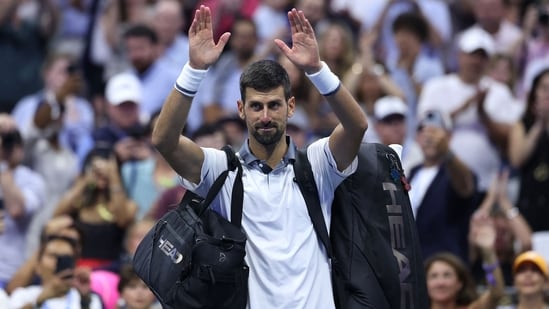
Just seven months back, Djokovic rivalled two-time Australian Open winner Jannik Sinner in the semis, then pushed Carlos Alcaraz to four sets in the final before going down.
As midnight closed in on the crowd at a packed Arthur Ashe Stadium in Queens, Djokovic was down on his knees. He was physically ailing — struggling to move at times, vomiting on multiple occasions.
Deep Dive
What physical issues did Novak Djokovic face during his match at the US Open 2026?
Why did Novak Djokovic consider retiring during his match against Mariano Navone?
How has Djokovic's performance in recent Grand Slam tournaments reflected his physical challenges?
This was not the version of Djokovic that Arthur Ashe Stadium had witnessed before, a venue the Serb had made one of his fortresses en route to four titles and 19 straight first-round wins before Sunday. It was a resume built on outlasting men across three generations, and rivalling the best of all of them.
This Djokovic was different. Chest heaving, towel pressed to his mouth, back aching, and the sound of the crowd softening into something between a groan and a hush. It was all too much for the 39-year-old, and he later, in the flat, unadorned way he has taken to describing his body's betrayals this year, admitted to even considering retiring from the match at the end of the first set. "Yes, I did, I did," he said. "I did, but then I won a set and then another." He didn't quit. He rarely does. Amid the struggle, there was a glimpse of vintage Djokovic as he mounted a fightback across the next two sets. He believed. The crowd believed. But his body gave up, yet again.
{{/usCountry}}This Djokovic was different. Chest heaving, towel pressed to his mouth, back aching, and the sound of the crowd softening into something between a groan and a hush. It was all too much for the 39-year-old, and he later, in the flat, unadorned way he has taken to describing his body's betrayals this year, admitted to even considering retiring from the match at the end of the first set. "Yes, I did, I did," he said. "I did, but then I won a set and then another." He didn't quit. He rarely does. Amid the struggle, there was a glimpse of vintage Djokovic as he mounted a fightback across the next two sets. He believed. The crowd believed. But his body gave up, yet again.
{{/usCountry}}His back started aching, then his shoulder, his body could barely allow him to serve, which dropped into the mid-90s. He won just one game in the last two sets as Mariano Navone of Argentina clawed back to pull off the unthinkable. By the fifth set, broken twice early, Djokovic stood behind the baseline and sobbed as the result turned inevitable.
7-6(5), 5-7, 4-6, 6-2, 6-1. Four hours and 36 minutes.
This was Djokovic's earliest exit from a Grand Slam tournament in 20 years — the last coming at Melbourne Park, when he featured as an unseeded teenager nobody outside tennis had heard of.
"The vomiting, the gagging, it's a serious problem. Then my whole body started to give way, with cramps and pain. In the end, my back and shoulder also gave out, and I couldn't finish the match the way I wanted. I was a break up in the fourth set, but I had already been struggling a lot from the fourth game onwards," he said afterward, on what ailed him in the round-one loss.
That scene in New York, those words to the media — they sound all too familiar. It was just 15 days earlier that Cincinnati had witnessed the same, as Djokovic went down in his opening match against Thiago Agustín Tirante: down on his knees, calling for a medical timeout, seen vomiting into a towel.
It was his first match since his Wimbledon semifinal loss to Sinner, before which he had admitted his body was in the best shape heading toward the US Open. The reflection on court told a different story. What he told the media afterward sat somewhere between a confession and a shrug.
"It's just a condition that I have, health-wise, that has been bothering me for the past couple of years," he said. "A lot of issues, especially when it is humid and it is hot."
The warning signs were there, and New York showed them again — enough, perhaps, for Djokovic to consider it all more seriously now.
Is it the pressure of the 25th major?
One could say so. Since his last Grand Slam title, at the 2023 US Open, he came closest to number 25 at Wimbledon the following year, denied by Alcaraz. But 2025 was a testament to what Djokovic remained capable of even in his late 30s, with his old rivals gone from the scene — he reached the semifinals at all four majors, including a hamstring injury suffered mid-match in the Australian Open semifinal against Alexander Zverev that still didn't stop him getting there. He took it one step further at the start of 2026, reaching the Australian Open final — a tournament he's won a record ten times — only to fall to Alcaraz in four sets. That was enough to make him believe the 25th major wasn't so far away. And even that final defeat didn't stop him from reiterating that the 2028 Los Angeles Olympics would be his swansong.
But just as Agassi said, "when it does come, it always comes fast."
At the French Open, he went down in five sets in the third round to teenager João Fonseca, a match that again featured visible physical distress. Wimbledon ended in a straight-sets semifinal loss to Sinner, after a gruelling five-set quarterfinal against Felix Auger-Aliassime in which he picked up a calf issue. Then Cincinnati. Then this.
Djokovic arrived in New York among the favourites, despite what had unravelled in Cincinnati. With an injured Alcaraz only just back from a four-month absence and defending champion Sinner out of the draw entirely, Djokovic dared to dream. Draws like that don't reappear on command at 39. He has spent three years chasing this number — the one that would put him outright ahead of Margaret Court, the one that would settle, statistically at least, an argument he's spent a career trying to win.
Djokovic has never admitted as much in so many words. But watching what happened in the space of 15 days, it's difficult not to wonder whether the mind has been pushing a body that has quietly started sending back its own answer.
A revised finish line
The Los Angeles Olympics are still two years away. Djokovic will be 41 by then. What looked plausible a month ago now carries more questions than answers. He has spent his career answering questions like these on his own terms, and it will be worth watching what he decides after this seismic loss.
There was another pattern buried in his 2026 season, one that says as much as the scorelines themselves. Of his last 11 match wins across tournaments this year, only one came in straight sets — against Stefanos Tsitsipas at Wimbledon. The routine dispatches that once padded his record have all but disappeared; what's left are the grinding, five-set survivals, and increasingly, he isn't surviving them.
As Agassi put it in the same documentary: "I would hope for him that he doesn't wait for too long — not because he can't win anymore, but because tennis takes your childhood. But then it gives you a chance to be done with your success, so that you can raise your children without the preoccupations."
Whether Los Angeles remains the finish line, or whether 2026 turns out to be the year that moved it closer, is now the only question that matters about what's left of Djokovic's career.