I don't remember the last time I went this many days without switching off my air purifier. For the past 10 days, it has been running almost non-stop at home, and looking at the worsening air quality, I don't see myself turning it off anytime soon. While I can do little about the pollution outside, I can at least pay attention to the air I breathe indoors.
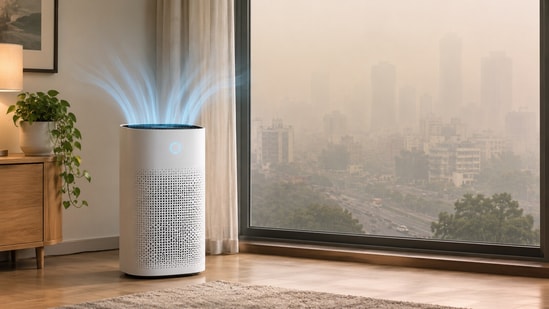
This has also made me realise how important it is to choose an air purifier that suits the room, rather than simply picking one based on its price or feature list. I would look at factors such as CADR, room coverage, filtration technology, noise levels and the cost of replacement filters before making a purchase.
If you are also planning to invest in one this season, I have shortlisted five air purifiers that are worth considering for different homes, needs and budgets.
Choose better. Buy smarter.
NEHA by HT Tech generates recommendations using proprietary AI analysis built on years of editorial expertise.{{#product}}{{/product}}
At ₹9,149, the Honeywell Air Touch V2 is one of the more affordable options in this list, particularly for buyers looking to equip a bedroom or a compact living space. Its 388 sq. ft. coverage and CADR of up to 250 m³/hour give an indication of the room size it is designed to serve. What caught my attention is its four-layer filtration setup.
Along with an H13 HEPA filter and activated carbon layer, Honeywell has included a Nano-Silver Anti-Bacterial Filter, supported by a pre-filter for larger airborne particles. The purifier also uses 3D airflow to distribute filtered air across the room. Honeywell claims it can remove up to 99.99% of micro-allergens and airborne pollutants, including PM2.5 and PM10.
Why choose this product?
Choose the Honeywell Air Touch V2 for its four-stage filtration, H13 HEPA filter and 388 sq. ft. coverage at a sub- ₹10,000 price.
{{#product}}{{/product}}
Our Principles
Full Transparency
Every product review clearly lists the Pros and Cons, giving you a balanced view.
Brand Confidence
We focus on products from brands with a proven reputation and long-standing market trust.
The Qubo Q1000 takes a different approach from basic air purifiers by combining high air-cleaning capacity with app-based controls. Its 600 m³/hour CADR and claimed coverage of up to 1,000 sq. ft. make it suitable for buyers looking to clean air across larger indoor spaces. The five-stage filtration system includes two pre-filters, a Nano-Silver antibacterial coating, activated carbon and a True HEPA H13 filter.
I particularly like the flexibility offered by its four operating modes. The AI mode can switch the purifier on or off based on air quality, while Manual mode gives users direct control. Another detail worth noting is its claimed filter life of up to 9,000 hours, which could reduce the frequency of filter replacements, depending on usage and pollution levels.
Why choose this product?
Choose the Qubo Q1000 for its high CADR, broad claimed coverage and connected controls that let you monitor and manage air quality remotely.
{{#product}}{{/product}}
The Winix 5500-2 brings air quality monitoring into the picture, which is particularly useful when outdoor pollution levels keep fluctuating. Its built-in sensors monitor PM1 and PM2.5 levels, while the Auto mode adjusts the purifier's operation according to the detected air quality.
For filtration, it combines a True HEPA filter with an activated carbon filter to tackle airborne particles and household odours. The purifier is also positioned for homes dealing with pet allergens, smoke and dust. Its claimed coverage of up to 1,881 sq. ft. is another selling point.
Why choose this product?
Consider the Winix 5500-2 for its advertised large-room coverage, particle monitoring and three-year warranty, but verify the specifications before buying.
{{#product}}{{/product}}
The Philips AC0920 is a compact air purifier aimed at bedrooms, studies and other smaller spaces. Its 250 m³/h CADR is paired with a two-layer HEPA NanoProtect filtration system, which Philips claims captures 99.97% of particles as small as 0.003 microns.
I also like that it keeps the controls simple, like you can check real-time air quality through the AeraSense display and adjust the fan speed directly on the device, without needing an app. For bedroom use, the Sleep mode is worth noting, with noise levels claimed to go as low as 20.5 dB. It draws 21W at full power and has a lightweight 2.5kg body, so moving it between rooms should be easy.
Why choose this product?
Choose the Philips AC0920 for compact bedrooms, quiet nighttime operation and real-time AQI monitoring, backed by a lightweight design and low power consumption.
{{#product}}{{/product}}
Priced at ₹11,999, the Coway Airmega 100 (AP-0823E) is suited to bedrooms and compact home-office spaces of up to 270 sq. ft. It uses a 3-in-1 True HEPA and carbon filter to capture dust, smoke, PM1 and PM2.5 particles, with Coway claiming up to 99.99% removal.
The filter is rated for 8,500 hours of use, while the seven-year warranty adds long-term value. Push-button controls keep operation simple, without app-based features.
Why choose this product?
Choose the Coway Airmega 100 for its long filter life, seven-year warranty and essential HEPA-carbon filtration in bedrooms or compact home-office spaces.
Which filter technology should I look for in an air purifier?
I would prioritise a genuine HEPA filtration system, preferably H13-grade or equivalent, as it can capture at least 99.95% of airborne particles measuring 0.3 microns under specified test conditions. This includes fine particulate matter such as PM2.5, which is a major concern in polluted cities. I would also look for an activated carbon filter if odours, smoke and certain gaseous pollutants are concerns. The overall filtration design and proper sealing matter as much as the filter specification.
Is a higher CADR always better when buying an air purifier?
I wouldn't automatically choose an air purifier simply because it has the highest CADR. The clean air delivery rate indicates how quickly a purifier can filter air, but the ideal rating depends on the room's size and ceiling height. I would calculate my room's approximate area and choose a model with sufficient capacity for repeated air circulation. A higher CADR can be useful for larger spaces, but it may also mean higher fan noise or power consumption.
Are air purifiers effective against dust, pet hair and bad odours?
I would look beyond the HEPA filter when choosing an air purifier for dust, pet hair and household odours. A pre-filter can trap larger particles such as visible dust, lint and pet hair, while a HEPA filter captures finer airborne particles. For cooking smells, smoke and certain gaseous pollutants, I would look for an activated carbon filter. However, an air purifier cannot replace regular cleaning or eliminate every source of household odour.
Where should I place an air purifier for the best results?
I would place my air purifier in an area with sufficient clearance around its air intake and outlet, following the manufacturer's placement instructions. Keeping it away from curtains, walls and bulky furniture helps prevent airflow obstruction. For a bedroom, I would position it where air can circulate freely without directing the exhaust straight at the bed. I would also avoid placing it in a corner or behind furniture, as restricted airflow can affect its cleaning performance.
Features comparison of my top 5 air purifier recommendations
| Air purifier | CADR | Room coverage | Filtration |
| Honeywell Air Touch V2 | 250 m³/h | 388 sq. ft. | 4-stage, H13 HEPA |
| Qubo Q1000 | 600 m³/h | Up to 1,000 sq. ft. | 5-stage, True HEPA H13 |
| Winix 5500-2 | Not verified | Up to 1,881 sq. ft. (listed) | True HEPA + carbon (listed) |
| Philips AC0920 | 250 m³/h | 320 sq. ft. (GB/T); 700 sq. ft. (NRCC) | 2-layer HEPA NanoProtect |
| Coway Airmega 100 | Not specified | 270 sq. ft. | 3-in-1 True HEPA + carbon |
Similar stories for you
- How does an air purifier work?
An air purifier draws in indoor air, passes it through filters that trap dust, pollen, smoke and other pollutants, and releases cleaner air.
- How many hours should I run an air purifier?
You can run an air purifier throughout the day, especially during high-pollution periods. Use Auto mode to adjust its operation based on indoor air quality.
- Which filter is best for an air purifier?
A True HEPA filter is a useful choice for capturing fine particles such as dust, pollen and PM2.5. Activated carbon helps reduce odours and gases.
- Does an air purifier help with PM2.5 pollution?
Yes, an air purifier with an effective HEPA filtration system can capture PM2.5 particles and help reduce their concentration in indoor air.
- How often should I replace an air purifier filter?
Filter replacement depends on the model, usage and indoor pollution levels. Check the manufacturer’s recommended interval and replace filters when the indicator signals it.
Disclaimer: At Hindustan Times, we help you stay up-to-date with the latest trends and products. Hindustan Times has an affiliate partnership, so we may get a part of the revenue when you make a purchase. We shall not be liable for any claim under applicable laws, including but not limited to the Consumer Protection Act, 2019, with respect to the products. The products listed in this article are in no particular order of priority.