A team of researchers at the Indian Institute of Technology, Ropar (Punjab) has developed a solution to deal with the leftover stubble. The researchers believe it will provide a sustainable and affordable solution to stubble burning, considered a major cause of deteriorating air quality in the national capital.
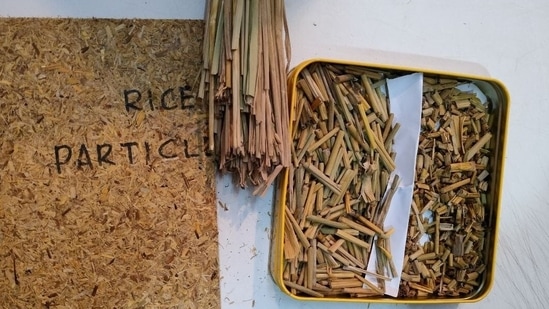
Led by IIT Ropar professor Dr Navin Kumar, the research team has developed an ‘agro-waste based microbial proof industrial viable particleboards.’ Through this technique, the unwanted rice straw can be moulded to usable boards that can be used in packaging, home decor, furniture and in temporary construction work by developing required strength.
“We collect the straws from farmland, then by applying a chemical process we remove cellulose which prevent growth of bacteria and fungus in future. After this, we put natural biodegradable resin to bind it, and then we hot press it, converting it into ply or as per the shape required in application,” one of the researchers told Hindustan Times at an event.
"To manufacture wooden ply, we need to buy wood, but in this solution the research claims that the cost is reduced three times as the raw material is available at a very low cost", the researcher added.
The research is still in the prototype stage, but the researchers believe it will provide a sustainable and affordable solution to stubble burning. They are also working to overcome some difficulties arising while the product is in trial.
{{/usCountry}}The research is still in the prototype stage, but the researchers believe it will provide a sustainable and affordable solution to stubble burning. They are also working to overcome some difficulties arising while the product is in trial.
{{/usCountry}}“We are trying to find a better biodegradable resin as an adhesive because currently the resin we use is water soluble. Because of this, we have to use urea formaldehyde in it, though in very little quantity. However, urea formaldehyde is toxic,” the researcher added.
Stubble burning
Farmers burn rice crop stubble - the lower short parts that are left standing after the rest have been cut, to prepare the fields for wheat sowing because there is a very brief window between paddy harvest and wheat sowing.
Stubble burning allegedly has the most prominent contribution to air pollution. A couple of days ago, the Gurugram administration warned farmers against burning crop residue by introducing a penalty at the rate of ₹2,500 per acre.