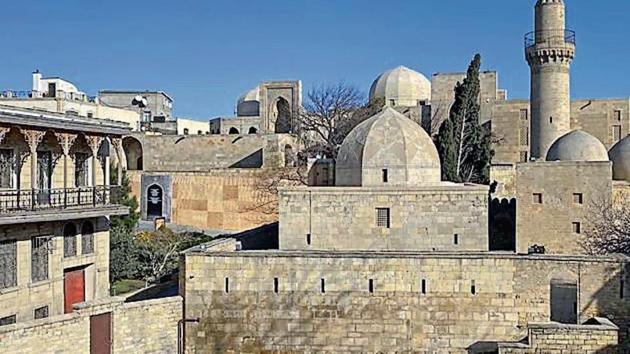
It’s a blustery morning in Baku, the capital of Azerbaijan, and from my high vantage point I have a sweeping view of the silvery Caspian Sea, a crescent of flamboyant architecture of the oil boom era and the old citadel with its ancient wall, minarets and domes. Behind me stand the three impressive flame-shaped towers, symbolic of ‘The Land of Fire’
Fuad Akundov, my engaging guide is delivering a nugget a minute, and he ventures a description; ‘Today Baku looks like Paris, with the layout of Naples, a citadel that reminds you of Damascus, and the winds of Chicago!’
The old city, once a sleepy backwater, came to life because of its harbour and its key position on the old trading routes.
Natural flames have emanated from the ground for millennia, and it is said that before the Arab conquest in 861 CE, these folks were fire-worshipping Zoroastrians.
My visit the day before, to Yanardag on the outskirts of Baku - where I warmed my hands on a strip of fire along a hillside that has been around for 3000 years - was followed by exploring the nearby Ateshgarh temple, built and added to by Indian traders from 1710-1813. Now a museum, the structure still has scared fires burning in the sanctums, and the Gayatri Mantra was playing in one of the chambers. A busload of visitors from India decanted and flowed right in. I learned that back in time Brahmins came here, ‘to seek their physical death in the land of holy flames in order to achieve spiritual immortality.’
{{/usCountry}}My visit the day before, to Yanardag on the outskirts of Baku - where I warmed my hands on a strip of fire along a hillside that has been around for 3000 years - was followed by exploring the nearby Ateshgarh temple, built and added to by Indian traders from 1710-1813. Now a museum, the structure still has scared fires burning in the sanctums, and the Gayatri Mantra was playing in one of the chambers. A busload of visitors from India decanted and flowed right in. I learned that back in time Brahmins came here, ‘to seek their physical death in the land of holy flames in order to achieve spiritual immortality.’
{{/usCountry}}Interestingly, the very first oil tanker built and used by the Nobel brothers here in Baku in 1879 was named ‘Zoroaster’
Today’s Baku is an oil-enriched, gleaming city of impressive art galleries, world class restaurants and magnificent modern architecture such as the Heydar Aliyev Centre designed by Zaha Hadid, the Carpet Museum with a half-rolled Azeri rug for a roof, and the triad of Flame Towers that house offices, apartments and a hotel. At night, they’re lit by the LED lights and resemble red-hot flickering flames, a fitting motif for the city.
Even more impressive are Baku’s hospitable and thoughtful denizens, who chose, despite being a Moslem Majority, to remain secular and embrace all religions.
Here, Jazz and traditional Mugam music are played side by side, wine and pomegranate juice are equally venerated, and Asian and European values are both woven into the fibre of their being.
Follow more stories on Facebook and Twitter
Catch your daily dose of Fashion, Taylor Swift, Health, Festivals, Travel, Relationship, Recipe and all the other Latest Lifestyle News on Hindustan Times Website and APPs.
Catch your daily dose of Fashion, Taylor Swift, Health, Festivals, Travel, Relationship, Recipe and all the other Latest Lifestyle News on Hindustan Times Website and APPs.