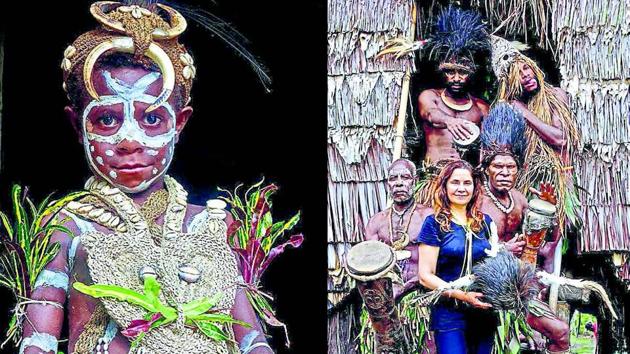
I’m breezing along on the Sepik River, on what feels like a crocodile. It’s a dugout canoe, long and slender, slung low in the water, with two reptilian eyes carved on the prow ahead of me. It’s just wide enough to squeeze in a cane chair, my only comfort, and my bare hands and feet feel the musculature of the water as we power upriver through it with a small, outboard motor. The feeling of speed is exhilarating, and the scenery of wild sugarcane reeds topped with white whisks, palm trees, green thickets and tiny waves glinting in the sunlight is soul strengthening. The Sepik river is around 1100 km long and with barely anyone around, it feels as though I have it to myself. We fly past houses on stilts made of palm bark and sago thatch, and the odd woman in a tiny dugout checking her fishing line. I’m in a remote corner of Papua New Guinea, so remote that little news makes it’s way here, let alone any newspapers. The Prime Minister of the country has changed and most people in the villages won’t have wind of it for a while.
Over the last few days, on our stopovers, I’ve had a chance to mingle with the warm, affable river people in their small settlements and villages such as Yentchen, Palembei, Kanganamun and Kamanibit. Some of them speak a little English in addition to Tok Pisin, the local pidgin spoken all over Papua New Guinea and their local language.
They shared fresh fish, sago bread, sweet potatoes, and coconut rice, and welcomed me into their homes where I slept under mosquito netting on light, trembling floors and walls of woven palm and pandan. The roosters seemed to delight at waking everyone with strident calls starting at 4am. The soil was still wet from the rains and a swollen river, and a handful of girls found my pathetic balance on wooden trunks leading to distant loos quite amusing. The rhythm and cadence of daily lives here has remained the same for eons, save a few changes. The women set off early in their small boats to fish, or to barter goods with nearby folks, they come home and grind sago, smoke fish, cook, attend to their vegetable patches, tidy up the house and yard, look after the kids and in their free time they make carrying bags and jewellery with twine and shells and catch up with friends and family.
{{/usCountry}}They shared fresh fish, sago bread, sweet potatoes, and coconut rice, and welcomed me into their homes where I slept under mosquito netting on light, trembling floors and walls of woven palm and pandan. The roosters seemed to delight at waking everyone with strident calls starting at 4am. The soil was still wet from the rains and a swollen river, and a handful of girls found my pathetic balance on wooden trunks leading to distant loos quite amusing. The rhythm and cadence of daily lives here has remained the same for eons, save a few changes. The women set off early in their small boats to fish, or to barter goods with nearby folks, they come home and grind sago, smoke fish, cook, attend to their vegetable patches, tidy up the house and yard, look after the kids and in their free time they make carrying bags and jewellery with twine and shells and catch up with friends and family.
{{/usCountry}}The men build homes, carve canoes, bring sago trunks home, and carve masks, flutes and totemic sculptures.
Christian missionaries introduced western style clothing, so the men wear second hand T-shirts and shorts and the women are clad in long, loose colourful printed blouses over sarongs. There are churches and schools around, but often not within easy reach, and all the kids I saw were happily goofing off as the paths were under water. The only way to get around is by small canoes, and not everyone has access to one.
The people are dark skinned Melanesians and they wear their coiled hair short, with the women styling it in various, ever-imaginative ways. Chewing betel nut and lime is an all-pervasive addiction, and children too have red teeth and mouths, and everyone goes about squirting the stuff unselfconsciously.
The men don’t hold back when skirmishes break out over land, women and pigs.
Nathan, who is guiding me, has organized visits to the few haus tamburans, or spirit houses that have survived in these parts. The local women are not allowed anywhere near these secretive male-only chambers, but as a foreigner, I get more than a glimpse into the dark, smoky, eerie spaces strewn with human skulls and pig and possum jaws where men beat traditional, rousing rhythms on long garamut tree-trunk drums, convene for debates, share their sacred ways with young boys and initiate them into the fold by cutting crocodile patterns into their torsos front to back, which are meant to imbue them with the creature’s ferocity. Proud of their scars, they whip off their shirts avidly to show them.
Sailing upriver, we arrive at the remote and pristine Wagu Lagoon, where we spend the morning with exquisite birds of paradise on the hilltop, and then at night, I join the locals on a crocodile hunt. A torch captures their shining eyes, and a young man leaps off the canoe to grab two sharp-toothed, muscular and very vocal young ones. The next morning, after a few photos with them, we release them right back where they belong to loud claps and embrace the blissfully peaceful vistas.
Follow more stories on Facebook and Twitter
Catch your daily dose of Fashion, Taylor Swift, Health, Festivals, Travel, Relationship, Recipe and all the other Latest Lifestyle News on Hindustan Times Website and APPs.
Catch your daily dose of Fashion, Taylor Swift, Health, Festivals, Travel, Relationship, Recipe and all the other Latest Lifestyle News on Hindustan Times Website and APPs.