Two IIT Madras alumni have launched a $1 million prize challenge to solve five longstanding problems in materials science, with the aim of accelerating scientific discoveries using artificial intelligence.
(Also read: IIT Madras director walks into student mess during dinner in viral video, announces key achievement)
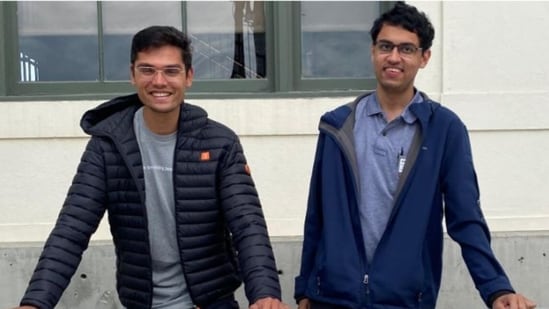
Advaith Sridhar and Akash Ramdas, who met more than a decade ago at IIT Madras, co-founded Discovered Materials, a San Francisco-based startup developing AI-powered methods to discover new materials for semiconductor chips, according to the company's official website.
As reported by TechCrunch on November 5, the startup, which participated in Y Combinator's spring 2026 batch, has enlisted academics from leading universities to identify five scientific problems that have remained unsolved despite years of research.
What are the five challenges?
According to Discovered Materials' official challenge website, the problems involve understanding cuprate superconductivity, predicting the electrical properties of semiconductor interfaces, and developing faster, more accurate methods for quantum chemistry calculations.
The remaining two challenges focus on understanding how light changes the behaviour of materials and predicting how heat travels across interfaces between solid materials.
{{/usCountry}}The remaining two challenges focus on understanding how light changes the behaviour of materials and predicting how heat travels across interfaces between solid materials.
{{/usCountry}}Solving these problems could help researchers develop more efficient electronic devices, improve semiconductor manufacturing and advance energy-related technologies.
Under the official competition rules, the largest prize, worth $400,000, is allocated to cuprate superconductivity. Two challenges offer $200,000 each, while the remaining two carry prizes of $100,000 each.
The competition is open to eligible individuals, teams and organisations, with no fixed deadline. Prizes will be awarded only if the proposed solutions meet the specified scientific criteria.
How did AI models perform?
Before launching the challenge, Discovered Materials tested advanced AI models on the problems, allowing autonomous AI agents to access the internet and other research resources.
However, the models made little progress despite working independently for several days, TechCrunch reported.
“How do we know AI is making progress?” Sridhar asked, highlighting the difficulty of measuring scientific breakthroughs in materials science.
Stanford professor Felipe Jornada, who helped develop the challenges, said, “Across materials science, there are phenomena we observe but cannot explain.”
Sridhar explained that the competition was intended to establish benchmarks for measuring scientific progress, regardless of who eventually solved the problems.
The startup had previously raised $9 million in seed funding in August to advance its semiconductor materials research.