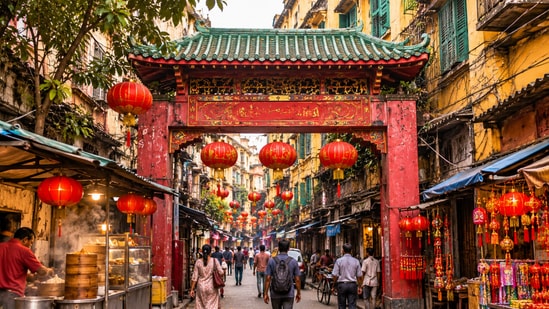
Kolkata is home to one of India's oldest Chinese settlements, but the story behind its historic Chinatown has an unexpected Italian connection. Located in central Kolkata, Tiretta Bazaar became an important centre for the city's Chinese community over time. Its name, however, goes back to an Italian immigrant who arrived in Calcutta in the 18th century and set up a market that would leave a lasting mark on the city.
Edward Tiretta: The Italian behind Kolkata's historic Tiretta Bazaar
Edward Tiretta was an Italian immigrant from Venice who made Calcutta his home in the 18th century. His original name was reportedly Edoardo. Some historical accounts suggest he left Italy following a political dispute, though the exact reason behind his move to Calcutta is not clear.
As The Indian Express reported, Tiretta worked as a civil architect for the government and went on to acquire property in the growing colonial city.
(Also Read: Nike CEO Elliott Hill makes family dinners non-negotiable despite demanding work schedule)
He later set up a private market on the land, which came to be known as Tiretta Bazaar. The market had become an established part of Calcutta by 1790, when British surveyor Aaron Upjohn included it on a map of the city.
The West Bengal tourism department's account of Kolkata's Chinatown also traces the market's origins to the Italian immigrant, stating that he acquired land from the East India Company to set it up. Over time, his name was adapted from Edoardo to Edward, while Tiretta also came to be locally referred to as Tiretti.
How did Tiretta Bazaar become Kolkata's Chinatown?
{{/usCountry}}The West Bengal tourism department's account of Kolkata's Chinatown also traces the market's origins to the Italian immigrant, stating that he acquired land from the East India Company to set it up. Over time, his name was adapted from Edoardo to Edward, while Tiretta also came to be locally referred to as Tiretti.
How did Tiretta Bazaar become Kolkata's Chinatown?
{{/usCountry}}Tiretta Bazaar was not always known for its Chinese community. The neighbourhood gradually took on that identity as Chinese migrants began settling in Calcutta. Among them were sailors who travelled along maritime trade routes between India and China, with some choosing to stay in the city rather than return home with their ships.
By the mid-19th century, Calcutta had a sizeable Chinese community. A glimpse of their lives appears in Chaloner Alabaster's account, The Chinese Colony in Calcutta, published in the Calcutta Review in 1858. He documented the community's occupations, which included shoemaking, carpentry, cabinet-making and other trades.
The neighbourhood came to be associated with the Chinese community and was locally known as Cheenapara, meaning the locality of Chinese people. Over time, it developed into a centre for Chinese businesses, food and community life.
(Also Read: Ex-Miss Thailand arrested for misusing charity donations to buy luxury homes: ‘I’m sorry, everyone’)
What remains of Kolkata's Old Chinatown today?
Kolkata eventually developed another Chinese settlement in Tangra. However, Tiretta Bazaar retains its place in the city's history as its original Chinatown, as detailed in The Telegraph's account of how Kolkata's two Chinatowns developed.
The Chinese community in the area declined over the decades, particularly following the 1962 Sino-Indian War, which affected livelihoods and led many families to leave the city. Historical research on Kolkata's Chinese community documents the changes that followed.
Yet, traces of its cultural legacy remain. The neighbourhood is still known for its traditional Chinese breakfast stalls, which serve steamed buns, dumplings and wontons, particularly on Sunday mornings, as The Telegraph has reported.
So, the next time you come across the name Tiretta Bazaar, remember that Kolkata's historic Chinatown carries the name of an Italian immigrant.