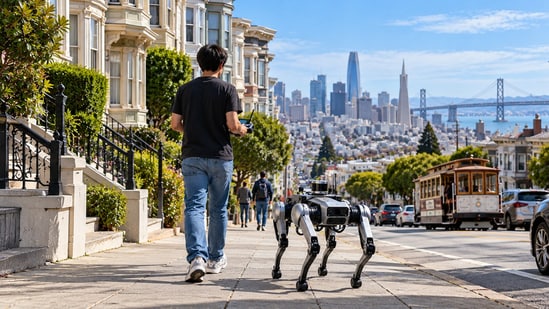
A San Francisco startup offered people $20 an hour to walk robot dogs through city streets, not for exercise but to help train artificial intelligence (AI) systems to navigate real-world environments.
(Also read: 'Science meets reality': Indie dog interacts with robot dog, netizens share mixed reactions)
According to a report by The New York Times, robotics startup Dimensional advertised for people to operate four-legged robots on outdoor routes lasting four to six hours. The unusual job required no previous robotics experience and included paid training.
The advertisement, posted in the Facebook group 'Bay Area Jobs' on October 5, has since been deleted.
What did the unusual job involve?
As reported by Fox Business, selected workers were expected to guide robotic dogs along designated routes around San Francisco, using a handheld controller or mobile application.
The company offered payment after every completed shift, with workers operating independently and following safety instructions.
{{/usCountry}}The company offered payment after every completed shift, with workers operating independently and following safety instructions.
{{/usCountry}}However, there was one unusual requirement. Applicants had to be comfortable handling equipment weighing approximately 33 pounds (15 kg).
Unlike real dogs, the robotic machines could suddenly stop functioning or overheat during a walk. If that happened, operators would have to carry them back to the company's office in San Francisco's Dogpatch neighbourhood.
Why was the startup paying people to walk robots?
Dimensional is developing an open-source operating system that would allow AI agents to control robots and perform physical tasks with minimal human intervention.
Its founder, 26-year-old Stash Pomichter, told The New York Times that human operators were helping the company collect real-world navigation data through cameras and sensors fitted to the robots.
The company then compared the machines' performance under human control with their performance when operated by AI agents.
The results showed that AI still struggled to control physical hardware independently.
"And humans are still needed in the loop," Pomichter acknowledged.
Startup's plans for the future
Dimensional has purchased more than 100 robot dogs and 50 humanoid robots from manufacturers in the US, China and Germany. The robots used during the San Francisco walks were manufactured by Chinese company Unitree and cost approximately $2,000 each.
The startup hopes its technology will eventually allow robots to perform physically demanding jobs in factories, data centres, construction sites and security operations.
"It's honestly barbaric that humans are still doing these physical tasks," Pomichter told The New York Times, referring to activities such as carrying heavy boxes.
For now, however, the experiment has demonstrated that human assistance remains necessary before robots can reliably navigate the real world on their own.