The most famous protester in modern Chinese history is “tank man”, the anonymous pedestrian who stared down a line of tanks next to Tiananmen Square in 1989. Last week a new protester captivated audiences beyond China: excavator man. On November 9th he drove a yellow construction digger up to a large government building in western China and started to rip at its façade—all caught on bystanders’ mobile phones. Part of the fascination with the story lay in the desperation of
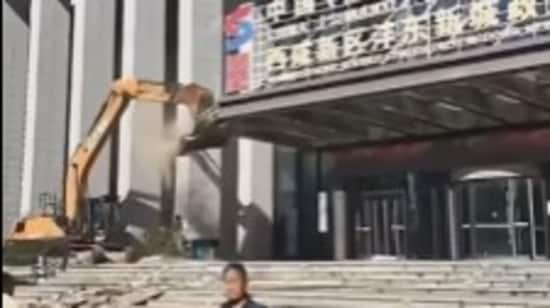
The most famous protester in modern Chinese history is “tank man”, the anonymous pedestrian who stared down a line of tanks next to Tiananmen Square in 1989. Last week a new protester captivated audiences beyond China: excavator man. On November 9th he drove a yellow construction digger up to a large government building in western China and started to rip at its façade—all caught on bystanders’ mobile phones. Part of the fascination with the story lay in the desperation of his act. The building, like the government itself, was at no risk of being toppled; the only certain outcome was that the man would be locked up.
Four days after videos of his protest spread across social media, Chaguan visited the site in Fengdong New City, just west of the historic capital of Xi’an. Dozens of police stood in front of the building—a service centre for the public. Hoardings already covered the walls struck by the man, who was identified by officials only as Mr Hu, aged 47. Workers drilled and hammered as they repaired the damage. Inside, people paid taxes and registered companies as usual. With police there, no one tarried to take photos.
But in the streets nearby, seemingly everyone knew about the protest. “It was a spectacle. We were all gawping,” said a shopkeeper. Officials have given no motive. Two versions have circulated online: one is that Mr Hu was owed money for construction work; the other that he was aggrieved over compensation for his demolished farm. A longtime resident on his way out of the service centre blamed the sprawling development across the street, where a village had been razed to make way for a thicket of office buildings and housing blocks. One thing, he said, was clear. “The government doesn’t have the money to pay what it owes. Even a clever cook can’t make a meal without rice.”
Whichever version is true, the saga in Fengdong is an extreme case of a grim reality for many: a property bust has drained local coffers, and ordinary people are last in line to be paid. Some are being pushed to the brink—and, as in the case of excavator man, over it. Chinese provinces and cities used to rely on land sales to generate nearly half their revenue. When the property sector went cold, land sales came to a halt, leaving local governments struggling to pay bills. Richer coastal cities are building new high-tech industries and broader tax bases. Places inland like Fengdong have had no such luck. They were in the midst of massive building sprees as the music stopped, and have little share of China’s new tech-driven economy.
The area around Mr Hu’s protest bears the scars of the property crash. Across the street from the building he attacked is the concrete core of a skyscraper that was supposed to reach 100 storeys, making it the tallest tower in north-western China, but it remains incomplete. Work stopped two years ago. Around it are other half-finished buildings; completed ones have padlocked doors, shattered glass and to-let signs. The troubles have reached the local government’s balance sheet. In May the state-owned group that oversees development of the Xixian New Area, which includes Fengdong, disclosed that it had nearly 3.7bn yuan ($550m) in overdue debt.
Signs of progress are few and faint. A nearby industrial park has attracted a genomics firm and a software developer. One forlorn building was repurposed a few months ago as a hub for “one-person companies”: small startups powered, supposedly, by artificial intelligence. Walking through its empty corridors, a visitor might call them “zero-person companies”. Even if some do eventually help the economy to grow, they will produce nothing like the windfall a decade ago from selling vast tracts of land. The government “can’t sell more land”, said the resident exaggerating only slightly.
Many places around China are in similar difficulty. In the first half of 2026 more than two-thirds of local-government financing vehicles—state-owned firms that turned land into property developments—did not earn enough to cover their interest payments, according to S&P, a credit-rating agency. Payments to suppliers are chronically late. Money owed to construction workers or to villagers as compensation easily slides to the bottom of the pile of bills. “There is nothing you can do. Suing them is pointless,” said a former road-construction contractor. In Fengdong, villagers showed up at the service centre every day for a month to demand payment, all to no avail, said the shopkeeper. “Officials delay and delay until they are transferred elsewhere,” he added.
One of Xi Jinping’s solutions has been to create a system of lifetime responsibility for debt. A party secretary or mayor who makes a mess like the one in Fengdong will, in theory, be on the hook many years later. That makes sense, but it has added to the chill: who wants to take risks that could haunt them forever? Pretty much the only construction in Fengdong was the renovation of the building damaged by Mr Hu.
Grated expectations
Do his actions signify that more people are beginning to vent their discontent in public? The contractor said a lesson from China’s long history is that it takes just one person to light a fire. On social media, the vast majority of comments were sympathetic. “Ordinary people have suffered too much,” read a typical one.
Yet there is scant evidence that Mr Hu’s lone act promises a popular movement. For potential copycats, the consequences are too frightening and the benefits too negligible. As a delivery driver in Fengdong put it, the important thing now is to get used to lower expectations. He can still put food on the table, so the situation is tolerable. That is hardly a ringing endorsement of his life. But as far as officials are concerned, what matters is that it is not a stinging denunciation. They can live with one excavator man.
Subscribers to The Economist can sign up to our Opinion newsletter, which brings together the best of our leaders, columns, guest essays and reader correspondence.
One Subscription.
Get 360° coverage—from daily headlines
to 100 year archives.
Archives
HT App & Website