
Pakistan is betting that a pair of nine-foot chicken wire fences topped with barbed wire will stop incursions by Islamist militants from Afghanistan, which opposes Islamabad’s plans for a barrier along the disputed frontier.
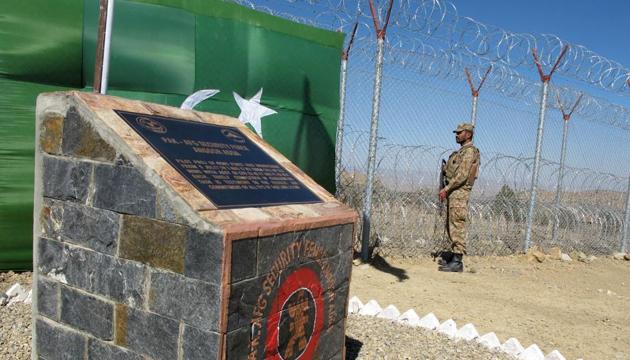
Pakistan plans to fence up most of the 2,500 km (1,500 mile) frontier despite Kabul’s protests that the barrier would divide families and friends along the Pashtun tribal belt straddling the colonial-era Durand line drawn up by the British in 1893.
Suggested For You
Pakistan’s military estimates that it will need about Rs56 billion ($532 million) for the project, while there are also plans to build 750 border forts and employ high-tech surveillance systems to prevent militants crossing.
In the rolling hills of the Angoor Adda village in South Waziristan, part of Pakistan’s restive Federally Administered Tribal Areas (FATA), three rolls of barbed wire are sandwiched in the six-foot gap between the chicken wire fences.
“(The fence) is a paradigm change. It is an epoch shift in the border control management,” said a Pakistani army officer in command of South Waziristan during a presentation to foreign media on Wednesday.
“There will not be an inch of international border (in South Waziristan) which shall not remain under our observation.”
{{/usCountry}}“There will not be an inch of international border (in South Waziristan) which shall not remain under our observation.”
{{/usCountry}}Pakistan’s military has so far fenced off about 43 km of the frontier, starting with the most violence-prone areas in FATA, and is expected to recruit tens of thousands of new troops to man the border. It is not clear how long it will take to fence the entire boundary.
But Pakistan’s plans have also drawn criticism from across the border.
Gulab Mangal, governor of the eastern Afghan province of Nangarhar, told Reuters the wall will create “more hatred and resentment” between two neighbours and will do neither country any good.
“The fence will definitely create a lot of trouble for the people along the border on both sides but no wall or fence can separate these tribes,” he said.
“I urge the tribes to stand against this action.”
Pakistan has blamed Pakistani Taliban militants it says are based on Afghan soil for a spate of attacks at home over the past year, urging Kabul to eradicate “sanctuaries” for militants.
Afghanistan, in turn, accuses Islamabad of sheltering the leadership of the Afghan Taliban militants who are battling the Western-backed government in Kabul.
Both countries deny aiding militants, but relations between the two have soured in recent years. In May, the tension rose when 10 people were killed in two border villages in Baluchistan region.
The clashes occurred in so-called “divided villages”, where the Durand Line goes through the heart of the community, and where residents are now bracing for the fence to split their villages in two.
Pakistan’s previous attempts to build a fence failed about a decade ago and many doubt whether its possible to secure such a lengthy border.
But Pakistani army officials are undeterred by the scepticism and insist they will finish the job as the country’s security rests on this fence.
“By the time we are done, inshallah, we will be very sure of one thing: that nobody can cross this place,” said the Pakistani officer in charge of South Waziristan.
Explore More
ABOUT THE AUTHOR
Follow the latest breaking news, major developments and agenda-setting stories from India and around the world with the newsdesk at Hindustan Times. Operating round the clock, the desk brings together experienced editors, reporters and correspondents to deliver fast, accurate and contextual reporting across subjects that influence public policy, governance, business, society and international affairs. The HT News Desk covers politics, elections, government policies, the economy, business and markets, science and technology, the environment, law and order, infrastructure, education, climate issues and geopolitics, while closely tracking developments across states, institutions and global capitals. The team also leads coverage of major breaking news events, policy announcements, court proceedings, natural disasters, public emergencies and significant international developments. Reports published by the newsdesk are based on information gathered from reporters on the ground, official statements, government agencies, court records, regulatory filings, recognised institutions and other authoritative sources. Stories undergo editorial scrutiny and verification processes to ensure accuracy, fairness and relevance, and are updated as events evolve and additional information becomes available. Whether covering a key political decision in New Delhi, an economic policy shift affecting millions, a landmark court ruling or a major global event, the HT News Desk aims to provide readers with reliable, fact-based journalism that delivers not only the latest developments but also the context and analysis needed to understand their wider implications.