Ahead of a planned summit of the Quadrilateral Security Dialogue, Indian Prime Minister Narendra Modi and his Japanese counterpart Yoshihide Suga agreed on Tuesday to bolster cooperation both bilaterally and through the four-nation group to ensure a free and open Indo-Pacific.
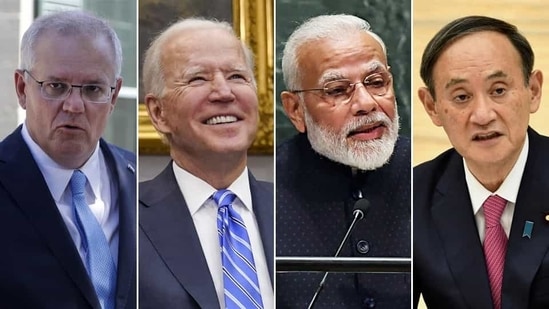
During a 40-minute phone conversation, the two prime ministers also discussed defence and security cooperation and Suga expressed serious concerns about China’s actions in the area ranging from Hong Kong to East China Sea.
The conversation came ahead of a planned summit of the leaders of the Quad nations – India, Australia, Japan and the US – that is expected to be held as early as Friday as part of the Biden administration’s focus on bolstering the group and countering China’s actions across the region.
Modi and Suga “shared the recognition that cooperation towards realising a Free and Open Indo-Pacific is becoming increasingly important and to this end, shared the view to steadily advance both Japan-India bilateral cooperation and Japan-Australia-India-US quadrilateral cooperation”, said a readout from Japan’s foreign ministry.
There was no official word on the conversation from the Indian side.
{{/usCountry}}There was no official word on the conversation from the Indian side.
{{/usCountry}}The two prime ministers also exchanged views on bilateral relations and “concurred that they would continue their effort to materialise the ‘Japan-India Special Strategic and Global Partnership’ through cooperation in such areas as security and defence, economic relationship including digital fields and people-to-people exchanges”, the readout said.
Suga expressed “serious concerns regarding unilateral attempts to change the status quo in the East and South China Sea, China’s Coast Guard Law and the situation in Hong Kong and the Xinjiang Uyghur Autonomous Region”, the readout said. While exchanging views on the regional situation, the two leaders “confirmed that they have grave concerns over the situation in Myanmar and they would closely work together in this vein”, the readout added.
Suga also sought “understanding and cooperation toward the early resolution” of the issue of Japanese citizens abducted by North Korea.
The two leaders welcomed progress on the high-speed rail project in Maharashtra and the signing of a memorandum of cooperation for specified skilled Indian workers to be employed in Japan.
Confirmation regarding the Quad Summit came from Australian Prime Minister Scott Morrison, who told a news conference last week he had discussed the matter with US President Joe Biden, Modi and Suga in recent conversations.
The US has taken the lead in organising both the summit and the third meeting of the foreign ministers of the Quad on February 18, against the backdrop of continuing concerns over China’s actions. During their meeting, the four foreign ministers reiterated the Quad’s commitment to a rules-based world order underpinned by respect for territorial integrity and sovereignty.
The Quad, formed in 2007, was revived in 2017 as a gathering of senior officials of the four countries. It was upgraded to the level of foreign ministers in September 2019, reflecting the desire of the four countries to work more closely on shared interests in the Indo-Pacific and India’s comfort with the group.