The moving finger writes, and having writ, moves on --- thus wrote Omar Khayyam, but a new review of 5,000 years of the act of writing covering several Indian examples shows that it is anything but as simple, as his ‘Rubaiyat’ suggests.
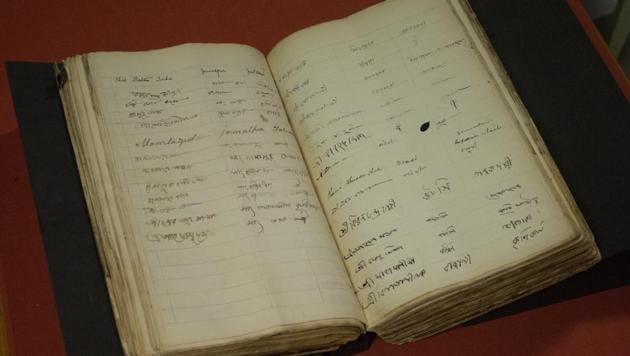
From carved stone inscriptions, medieval manuscripts and early printed works to beautiful calligraphy, iconic fonts and emojis, the British Library is hosting a major show until August 27, deconstructing the act of writing and considering its future in the digital age.
Several Indian examples feature in the narrative of writing that begins with Mesopotamia, Egypt, China and the Americas, exploring more than 40 writing systems, from the 5,000-year-old Jemdet Nasr clay tablet with very early cuneiform to digital typefaces and emojis.
Examples in the review titled ‘Writing: Making Your Mark’ include a sixteenth century Sanskrit text in the Nandinagari script of central India, with a line of Old Kannada script at the bottom, reflecting the time when copper and other metals were used.
The charter, written in both angular Nandinagari and curved Old Kannada scripts, was incised to record Sadasiva Raya’s grant of villages to a nearby religious community. His seal has been cast into the ring that holds the copper plates together.
{{/usCountry}}The charter, written in both angular Nandinagari and curved Old Kannada scripts, was incised to record Sadasiva Raya’s grant of villages to a nearby religious community. His seal has been cast into the ring that holds the copper plates together.
{{/usCountry}}Also on display is the famous petition against the partition of Bengal in 1905, signed by 60,000 people in Bengali and English. The written petition led to a discussion in the British parliament at the time, though it did not stop the partition.
A fine example of Indian calligraphy is the nineteenth century Rājnīti-Budhibāridh. A political treatise copied for Maharaja Ranjit Singh, fine Gurmukhi script is written in alternating red and black ink. The colour distinctions mark different verses in praise of the ten Sikh gurus, with the penmanship highlighted by the simple yet delicate double border of gold leaf.
A nineteenth century Devanagari Primer to teach children the script is complete with illustrated chart of the components and a guide to the combinations of consonants and vowels. The front cover is illustrated with the lithographed image of children learning from their teacher.
The collection includes an early example of the East India Company’s Court Book, dated 1657–66. The trading company set up in 1600 operated over vast distances, making it essential to maintain written records. Scribes were employed to take minutes of meetings; in this book, the scribe has playfully added a drawing of a hawk.
Adrian Edwards, lead curator of the exhibition, says: “From street signs to social media, writing surrounds us in the modern world and reflects the diversity of everyone who uses it around the globe”.
“In the 5,000 years since speech was first turned into symbol, written communication has stimulated innovations as varied as the printing press and smart phones”.