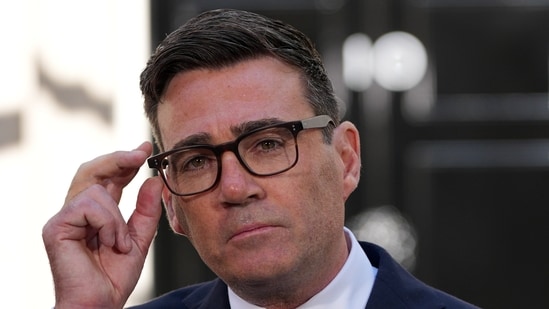
THE ARRIVAL of Andy Burnham as Britain’s prime minister is “the most significant change moment in our politics for 40 years”—at least, according to Mr Burnham himself. Entering 10 Downing Street on July 20th, he declared: “Let us make this the moment when Britain starts to believe again.”
The soaring rhetoric has not been matched by a transformative vision for government. Sixteen years after he first attempted to become leader of the Labour Party, and a year since he began
THE ARRIVAL of Andy Burnham as Britain’s prime minister is “the most significant change moment in our politics for 40 years”—at least, according to Mr Burnham himself. Entering 10 Downing Street on July 20th, he declared: “Let us make this the moment when Britain starts to believe again.”
The soaring rhetoric has not been matched by a transformative vision for government. Sixteen years after he first attempted to become leader of the Labour Party, and a year since he began planning for his new job in earnest, Mr Burnham has hit the ground strolling. He gives a good account of what he is against, but less of a firm impression of what he intends to do with his office.
The prime minister’s first task was a clear-out of the cabinet: he sacked all the closest allies of his predecessor, Sir Keir Starmer, including Sir Keir’s chancellor, Rachel Reeves. The casualties included most of those involved in crafting Sir Keir’s approach to the economy, which (in rhetoric if not always in practice) favoured tech, deregulation and a focus on housebuilding in order to gee up Britain’s sluggish growth: Peter Kyle, Steve Reed, Liz Kendall and Darren Jones were removed from their posts overseeing business, housing, science and the machinery of government, respectively. Mr Burnham’s ruthlessness in erasing his predecessor’s economic legacy fits with his recent diatribes against 40 years of “neoliberalism”.
The new chancellor, John Healey, is not a total break from the past, however. He served for five years as a Treasury minister in the government of Sir Tony Blair; his appointment, which came as a surprise to most observers, does not necessarily signal a radical deviation from economic orthodoxy. What it does indicate is that the prime minister is willing to spend a lot more on defence: Mr Healey resigned as Sir Keir’s defence secretary in June following a row over funding. (Will he somehow find the extra billions in military investment that the Treasury previously denied him?) Ed Miliband, who had been tipped for the chancellor’s job, becomes foreign secretary while another contender, Shabana Mahmood, remains home secretary—a sign that Mr Burnham backs her crackdown on both legal and illegal immigration.
Mr Healey’s first job will be to sign off on a package of measures intended to help Britons cope with the cost of living. He will also need to find the money to honour the prime minister’s first specific policy promise, to “end rough sleeping”—a project Mr Burnham also attempted, with limited success, while serving as mayor of Greater Manchester.
On foreign policy, the prime minister showed he understands where his priorities must lie with his first three phone calls to foreign leaders: he spoke to Donald Trump, Volodymyr Zelensky and Ursula von der Leyen, the head of the European Commission. His choice of Mr Miliband to run the Foreign Office, though, means the ministerial churn continues: Britain has now had seven different foreign secretaries in the past five years, a damning indictment of the country’s political turbulence and the inability of successive leaders to set a course and stick to it.
Concerningly, for a man who declared he was “ready”, Mr Burnham has signalled that some of his biggest decisions will be further delayed. He has promised to produce a “ten-year plan” some time in the autumn. This is likely to include his solution to the knotty problem of how to reform social care for the elderly. His biggest policy passion is the devolution of power from Westminster to the English regions, but even there he has provided little real detail. Britain’s problems are too urgent for its leaders to spend more time dawdling.
Despite a slow start, there are reasons to be optimistic about the new prime minister. His ability to keep his cabinet appointments almost entirely secret before they were announced is a stark contrast to recent governments. If he has applied the same level of discipline to his policy programme, it is possible that a robust set of ideas will be rolled out in the coming weeks, with the ten-year plan coming as a coherent endpoint rather than an attempt to start from scratch. His central message to the country on the steps of Number 10, that Britons need to rediscover their “common purpose”, is the right one.
But it remains dangerously plausible that his policy thinking is as thin as it looks, and that Mr Burnham’s government will end up being merely a version of Sir Keir’s with a northern accent. And a worse outcome is possible: he has refused to rule out some bad economic ideas such as rent controls and mass nationalisation of utilities, which would sap growth and destabilise the already shaky public finances. For now, and despite Mr Burnham’s three decades in public life, Britons still know remarkably little about the intentions of their new prime minister.
One Subscription.
Get 360° coverage—from daily headlines
to 100 year archives.
Archives
HT App & Website