
Anthropic’s record-setting initial public offering provided investors with one of the purest bets on the artificial-intelligence boom. So far, it’s also been a losing trade.
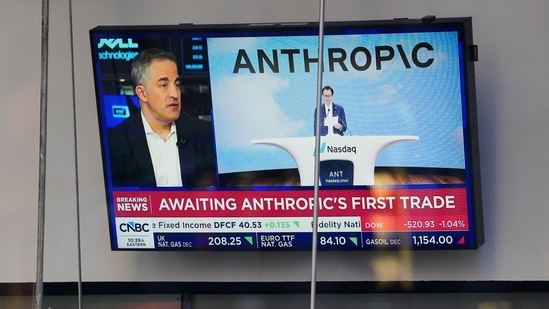
The company’s shares tumbled 6.5% Tuesday to $81.91, closing for the first time below its IPO price of $83. The stock opened on Thursday with an impressive 34% jump before those gains were swept away by a broader tech selloff.
Suggested For You
The drawdown resumed Tuesday after a one-day respite, owed to Nvidia co-founder Jensen Huang’s surprise
Anthropic’s record-setting initial public offering provided investors with one of the purest bets on the artificial-intelligence boom. So far, it’s also been a losing trade.
The company’s shares tumbled 6.5% Tuesday to $81.91, closing for the first time below its IPO price of $83. The stock opened on Thursday with an impressive 34% jump before those gains were swept away by a broader tech selloff.
Suggested For You
The drawdown resumed Tuesday after a one-day respite, owed to Nvidia co-founder Jensen Huang’s surprise return to the chip maker. Enthusiasm for what Huang’s reinstatement might mean for the AI build-out lifted the Nasdaq composite to its best day since the “Liberation Day” rebound in April 2025.
Stocks began to give back some of those gains immediately on Tuesday, with many investors revisiting the unresolved questions of the pace of the AI build-out and the likelihood the industry’s biggest players would meet Wall Street’s expectations for profits. Of particular attention: Anthropic, which developed the popular Claude model.
“It’s coming into an environment where everybody’s questioning AI,” said Matt Orton, chief market strategist at Raymond James Investment Management. “That was really its biggest challenge.”
Anthropic’s weak showing is unwelcome news for its chief rival, OpenAI, which is eager to stage its own IPO next year, and a slew of other AI-related companies eyeing offerings.
The selloff in AI stocks started taking shape weeks ago. And yet, Anthropic went through with its IPO anyway, raising over $100 billion between its IPO haul—the biggest on record—and a concurrent private placement. In fact, in the lead-up, the company had upped both its IPO price and offering size in response to fervent investor demand. Some analysts say Anthropic might have been better off sticking to its original plans.
As it were, Anthropic’s shares have fallen for three straight sessions, including Monday’s rally that lifted most of the U.S. market.
On Tuesday, the Nasdaq fell 1.5%. The S&P 500 slipped 0.5%, while the Dow Jones Industrial Average gained 0.9%, or about 423 points.
It isn’t uncommon for a newly public company to see its stock swing wildly in its first few days of trading. Facebook’s IPO was widely considered a disaster, even if the company eventually emerged as one of the market’s most-valuable stocks. Shares dropped below the IPO price after just two trading days.
Nevertheless, Anthropic has fallen back to earth faster than other recent hot IPOs. When SpaceX went public in June, the shares fell below the IPO price after 22 trading days. For Alibaba in 2014, it took nearly a year.
“You’re talking about a week-old stock. There’s a lot of supply to absorb,” said Jared Carmel, managing partner at Manhattan Venture Partners. “The market is still finding the price.”
But the day after Anthropic’s offering, investors were already pointing fingers on why the AI lab’s IPO had fizzled so quickly. Some questioned how the company and its bankers doled out the shares, including giving a large portion to existing backers. By Friday morning, the company said that its so-called green-shoe option had already been exercised, removing a potential tool for its underwriters to use to stabilize the stock in early trading.
Anthropic’s efforts to meet their expectations for investor demand might have hurt them this week, says Mandeep Singh, senior tech analyst at Bloomberg Intelligence. The higher number of shares issued in Anthropic’s IPO, along with the steeper price, has raised the bar for the company’s growth expectations among investors who have grown increasingly skeptical, he said.
“This was really a case where they raised too much money,” said Singh. “Had they stuck to the original pricing range and original plans…I think it would have come out fine.”
Some investors already had their doubts about Anthropic’s business model—among them the fear that the AI tools that the company sells to consumers and businesses will become commodified.
Janice Quek, an equity analyst at CFRA Research who has a “buy” rating on Anthropic, believes that the company will continue to be able to charge a premium for its cutting-edge models, pointing to evidence that customers have been sticking with its services despite the proliferation of cheaper AI products.
But, she said, “there are definitely a lot of risks to the thesis. Competition is definitely one thing. You definitely see more of these open-weight models coming into the picture.”
So have higher interest rates, which make financing the AI build-out more expensive. A Democratic sweep in the midterm elections will send a wave of data-center skeptics into state and federal office. For months, investors have been growing anxious for signs that the stock market’s four-year wager on AI technology is paying off.
“The prevailing sentiment for several years was that any money spent on AI was money well spent,” said Steve Sosnick, chief strategist at Interactive Brokers. “Even before Jensen Huang’s shenanigans, investors were really rethinking their approach.”
“I think the volatility surrounding the AI trade is far from done,” he added. “Even if we dodged a big bullet yesterday.”
Write to Hannah Erin Lang at hannaherin.lang@wsj.com, Krystal Hur at krystal.hur@wsj.com and Sam Goldfarb at sam.goldfarb@wsj.com
One Subscription.
Get 360° coverage—from daily headlines
to 100 year archives.
Archives
HT App & Website