
 E-Paper



Asim Munir becomes Pakistan's 2nd Field Marshal, the first was a dictator
With Asim Munir's promotion to the topmost military rank in Pakistan, the world is reminded of the country's turbulent past.

 Prefer HTon Google


Pakistan recently promoted General Asim Munir, its army chief, to the rank of Field Marshal, which is considered to be the highest rank in the country. With this promotion, Asim Munir becomes the second military officer in Pakistani history to be conferred the rank of Field Marshal.
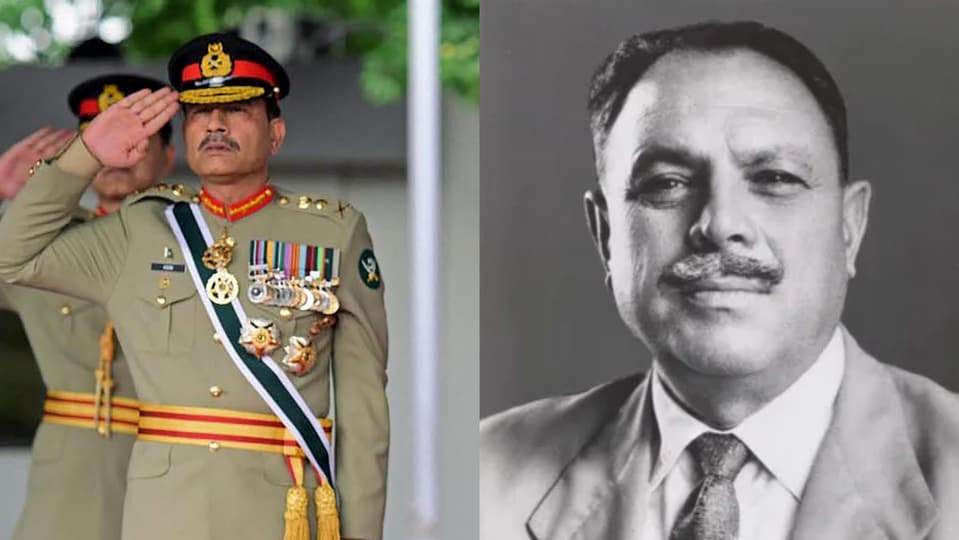
Munir's promotion comes against the backdrop of escalating tensions between India and Pakistan following the April 22 Pahalgam attack, which killed 26 people, and India's military strike Operation Sindoor.
Pakistan's history comes with multiple pages of military coups and absolute rule and among the key names is Field Marshal Muhammad Ayub Khan, who was the first and only military officer to be promoted to the top rank.
How Ayub Khan became a military dictator in Pakistan
After years of political unrest, frequent government changes, corruption and more, President Iskander Mirza declared martial law in October 1958 and appointed General Ayub Khan as the Chief Martial Law Administrator.
A move which came as part of the effort to restore order in the nation turned into the start of military rule in Pakistan. Twenty days after his appointment, Khan turned against the president and rose to absolute power.
In the coup of October 1958, Khan rose to power and ousted President Mirza. After the president's resignation and exile to the United Kingdom, Khan elevated himself as the President of Pakistan and marked Islamabad's first military takeover.
A year after the coup, Ayub Khan appointed himself as Field Marshal and proceeded to rule over Pakistan for the next 11 years. Following the second Indo-Pak war in 1965, Ayub Khan's popularity decreased and four years later in 1969, mass protests against him would result in his resignation.
Pakistan's turbulent past with military rule
Ayub Khan's resignation, however, did not end the military's influence in the Pakistani government. After Khan, General Yahya Khan took over as president. However, in 1971, a military coup led by military officers unhappy with the Yahya regime, called for his resignation and handing over of the government to Zulfikar Ali Bhutto.
Bhutto took the oath as president in 1972 and brought an end to martial law. However, in 1977, ZA Bhutto witnessed a similar fate like his predecessors.
A military coup led by Army Chief General Zia-ul-Haq took place six years after the liberation of Bangladesh and the third Indo-Pak war, calling for Bhutto's ouster and arrest.
After his takeover, Zia-ul-Haq proceeded to dissolve the national assembly as well as the Constitution of Pakistan.
In 1999, then prime minister Nawaz Sharif met with a similar fate and was overthrown by a coup led by Army Chief of Staff General Pervez Musharraf.
Musharraf also suspended the constitution and declared a state of emergency. With Musharraf in power, Pakistan also witnessed its fourth war with India - the Kargil war of 1999.
With Asim Munir's promotion to the topmost military rank in Pakistan, the world is reminded of the country's turbulent past, with military leaders taking over as dictators.
Unlike Ayub Khan's promotion, Asim Munir was appointed and promoted to Field Marshal by Prime Minister Shehbaz Sharif and President Asif Ali Zardari.
However, history tells us that General Zia-ul-Haq and General Pervez Musharaf were also appointed by their respective governments and prime ministers, yet still proceeded to overthrow them for military dictatorship.


