
The Chinese government has declined to reveal the budget for the ambitious China-Pakistan Economic Corridor (CPEC) economic corridor, saying that the finance model for it is market driven.
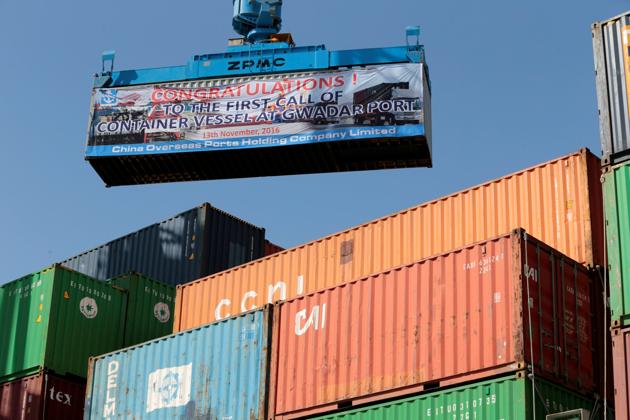
The budget for the multi-billion dollar CPEC, a cluster of projects that would connect Xinjiang in China’s west to the Gwadar port in Balochistan, has been variously put between $46 billion and, more recently, at $51 billion; the $46 billion number has been used more liberally.
Suggested For You
The CPEC is a flagship project under President Xi Jinping’s Belt and Road Initiative (BRI) which aims to connect China with the rest of Asia and Europe by land and over sea through infrastructure projects. India hasn’t signed up for BRI because the CPEC passes through Pakistan-occupied Kashmir (PoK). According to diplomats, India endorsing the BRI would mean giving up its claims on PoK.
Privately, Chinese experts say the CPEC budget numbers have been circulated by Pakistani officials and not by China. The ministry of foreign affairs told HT that, in fact, that there is no “specific budget” for the project.
“There is no specific budget for the construction of the CPEC. Instead, it follows international practices, adopting a market driven model, encouraging enterprises to play an essential role to move it forward. It (the project) is based on scientific evaluation and it is being implemented under the principle ‘operating when mature,’” the ministry told Hindustan Times in a written response.
It didn’t clarify whether the projected budget would be more than the numbers that are circulating. It also failed to answer as to how many CPEC projects would be inside PoK.
{{/usCountry}}It didn’t clarify whether the projected budget would be more than the numbers that are circulating. It also failed to answer as to how many CPEC projects would be inside PoK.
{{/usCountry}}Till September 2016, China had invested $14 billion in 30 early harvest projects to be completed under CPEC, Pakistani media quoted Chinese embassy deputy chief of mission Zhao Lijian as saying.
“During President Xi Jinping’s visit to Pakistan in April 2015, over 30 cooperation project agreements for the CPEC were signed. The project covers infrastructure, energy and industrial cooperation,” the ministry said in a written response to questions.
The ministry shared some details about the ongoing projects under the CPEC, saying that constructions under the CPEC were “progressing smoothly”.
Under transportation, the “Lahore city rail transit project, the phase II of Karakoram Highway upgradation project (from Thakot to Havelian), the Lahore-Karachi Expressway (from Sukkur to Multan) and construction for three other transport projects (relating to building) infrastructure have started,” the ministry said.
In the energy sector, construction work on 13 projects including the Sahiwal Coal Power plant in Punjab, the Port Qasim coal plant in Sindh and well as ZTE Energy Pakistan PV power plant also in Punjab were also going on, the ministry said.
On the model being followed to complete, the ministry said the CPEC was “open and transparent”.
“There are many countries (which have) expressed a strong interest to participate. It is believed that the corridor construction is not only beneficial to the development of China and Pakistan but also for the region and even outside countries,” it said.
The CPEC it added “provides platforms and opportunities for regional economic integration. It is also a great attempt for countries to develop mutually through support and helping each other.”
Explore More
ABOUT THE AUTHOR
Follow the latest breaking news, major developments and agenda-setting stories from India and around the world with the newsdesk at Hindustan Times. Operating round the clock, the desk brings together experienced editors, reporters and correspondents to deliver fast, accurate and contextual reporting across subjects that influence public policy, governance, business, society and international affairs. The HT News Desk covers politics, elections, government policies, the economy, business and markets, science and technology, the environment, law and order, infrastructure, education, climate issues and geopolitics, while closely tracking developments across states, institutions and global capitals. The team also leads coverage of major breaking news events, policy announcements, court proceedings, natural disasters, public emergencies and significant international developments. Reports published by the newsdesk are based on information gathered from reporters on the ground, official statements, government agencies, court records, regulatory filings, recognised institutions and other authoritative sources. Stories undergo editorial scrutiny and verification processes to ensure accuracy, fairness and relevance, and are updated as events evolve and additional information becomes available. Whether covering a key political decision in New Delhi, an economic policy shift affecting millions, a landmark court ruling or a major global event, the HT News Desk aims to provide readers with reliable, fact-based journalism that delivers not only the latest developments but also the context and analysis needed to understand their wider implications.