THE MACHINERY which moves money around is rarely inspiring. It is remarkable then that Pix, Brazil’s digital-payments system, has become a source of national pride after being assaulted by Donald Trump. On July 15th the Trump administration imposed a 25% tariff on a range of Brazilian imports after concluding a year-long trade investigation into what it called Brazil’s “unreasonable” practices.
Pix was prominent among the grievances. Launched by the Central Bank of Brazil in 2020, the system is beloved by
THE MACHINERY which moves money around is rarely inspiring. It is remarkable then that Pix, Brazil’s digital-payments system, has become a source of national pride after being assaulted by Donald Trump. On July 15th the Trump administration imposed a 25% tariff on a range of Brazilian imports after concluding a year-long trade investigation into what it called Brazil’s “unreasonable” practices.
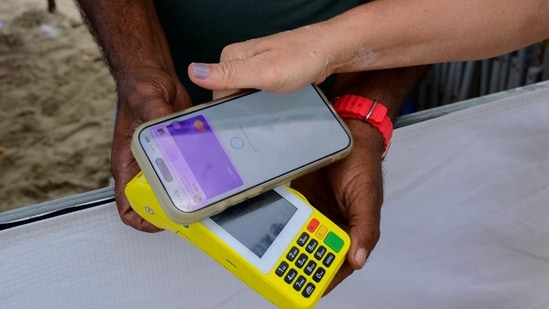
Pix was prominent among the grievances. Launched by the Central Bank of Brazil in 2020, the system is beloved by consumers for making payments instant and free. It is now part of everyday life in Brazil. Around 170m people—80% of the population—use it, and it accounts for more than half of the country’s payment transactions.
Some of the administration’s complaints about Brazilian trade practices have merit. Brazil is no free-trader. But the case against Pix rests on two shaky assumptions: that it is a protectionist tool and that it has damaged American payment companies (namely Visa and Mastercard). Neither is supported by evidence.
Take protectionism. The complaint accuses Brazil of putting American firms at a disadvantage, but Pix’s rules do not distinguish between domestic and foreign participants. Any financial institution licensed in Brazil and operating there—as Visa and Mastercard do—is free to connect to the network on the same terms. All banks, Brazilian or foreign, with more than 500,000 account-holders in the country, are required to offer Pix to their customers. But there is no requirement for payment processors like Visa and Mastercard to sign up. They have done so voluntarily. If anything, Pix makes it easier for all foreign payment firms to reach Brazilian consumers, not just the giant incumbents.
The Trump administration also complains that Brazil’s central bank both operates Pix and regulates it. The arrangement does raise legitimate questions about giving so much control over a payments system and the financial data it generates to a single institution. But those are concerns about concentration of power, not discrimination against foreign firms. Governments build, own and regulate essential infrastructure routinely. There is nothing inherently discriminatory about applying the same model to payments, argues Monica de Bolle, a senior fellow of the Peterson Institute for International Economics, a think-tank in Washington.
The second assumption—that Pix has harmed American payment companies—is also weak. It rests on a misunderstanding of why Pix was created, says Daniel Santos Kosinski, a professor of economics at the State University of Rio de Janeiro. Before Pix, existing services, including those offered by foreign firms, charged fees for electronic payments that poor Brazilians could not afford. Pix was built to change that. The central bank estimates that at least 70m people have entered the formal financial system since its launch.
Far from cannibalising other electronic payment methods, Pix has expanded the market. It has done so at the expense of cash and cheques, the use of which has plummeted. The number of cash withdrawals made every quarter has fallen by 46% since Pix was introduced (see chart).
This has strengthened Brazil’s banking system. By making transfers free to consumers and instantaneous, Pix encouraged people to keep wages and savings in bank accounts instead of withdrawing them. A study by Lars Norden of the Getulio Vargas Foundation (FGV), a university in Rio de Janeiro, and colleagues found that banks in municipalities with greater Pix adoption saw their deposits grow faster. The effect was even stronger in places that had large informal economies. Another study by José Renato Haas Ornelas and colleagues from the central bank found that businesses were more likely to accept debit cards in places where Pix was more widely used. The number of credit-card transactions in Brazil has increased by 127% since 2020.
That does not mean incumbents face no pressure. Pix has changed the economics of payments. Bernardo Guimarães of the FGV says this may eventually squeeze the profits of Visa and Mastercard in the country—but through lower fees, not fewer transactions. Businesses in Brazil typically pay around 2% of credit-card sales to a payment processor. A Pix payment costs next to nothing. The result is greater pressure on all payment processors, big and small, to justify the fees they charge.
Pix has also made Brazil’s banking sector more competitive. Before its launch in 2020, part of the reason customers often stayed with large incumbent banks was because moving money was slow and expensive. Making Pix transfers free and instantaneous has reduced the cost of switching, making it easier for smaller and digital banks to compete for customers.
The Trump administration’s deeper concern may be that Pix will become a model for the rest of Latin America, eroding American card networks’ profits and their influence across the region. But that, too, is misguided. As Ms Bolle notes, Pix was the product of Brazil’s particular circumstances: a powerful and trusted central bank that could require big banks to join the system, and a huge domestic market in which millions of people still relied on cash. It also took years to design and test. Few countries if any in Latin America have the same conditions. Mexico, the second most-populous country in Latin America, launched CoDi, its own instant-payments platform, in 2019. Adoption has remained anaemic: by 2024 only 1.6% of Mexicans had used it.
The biggest beneficiary of Mr Trump’s campaign against Pix may well be Luiz Inácio Lula da Silva, Brazil’s president, known as Lula. His political fortunes have improved recently ahead of a presidential election in October, thanks to his right-wing rival Flavio Bolsonaro’s connection to a vast fraud scandal. America’s assault on Pix is another electoral gift. The system is one of very few entities that enjoys broad support across deeply polarised politics. Mr Trump’s campaign against it has allowed Lula to cast himself as the defender of one of Brazil’s most successful public innovations and, by extension, of sovereignty. The slogan “O Pix é nosso” (“Pix is ours”) has been spreading online. Lula has been appearing at rallies holding signs proclaiming that “Pix belongs to Brazil”.
That leaves Mr Bolsonaro in an awkward position. His family’s close alliance with Mr Trump makes it tricky to defend Pix from his attacks. On July 2nd Mr Bolsonaro tried to find a workable line, suggesting to the Trump administration that Pix be blocked from connecting to payment systems run by countries such as China and Russia. Lula immediately accused him of wanting to “hand over Pix to foreign interests”, and cast him as being more interested in pleasing America than defending Brazil. Memes mocking Mr Trump and Mr Bolsonaro proliferated. So far, all America’s campaign against Pix has achieved is to give Brazilians one more reason to love their payments system.
One Subscription.
Get 360° coverage—from daily headlines
to 100 year archives.
Archives
HT App & Website