The Cambridge Dictionary has named ‘human’ its word of the year for 2026, reflecting growing global debates over what it means to be human as artificial intelligence (AI) increasingly blurs the boundaries between people and machines.
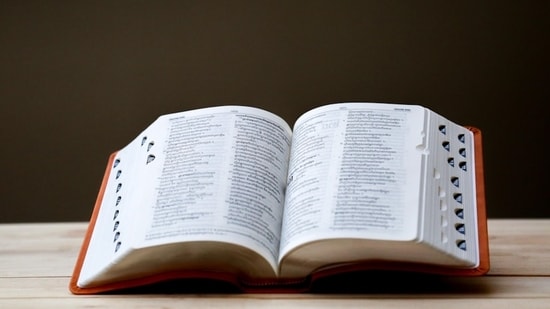
The Cambridge Dictionary defines ‘human’ as “having the qualities, faults, and feelings that people have, as opposed to gods, animals, or machines”.
“The choice of ‘human’ reflects a defining paradox of the AI era: as technology becomes more capable and more present in everyday life, distinctly human qualities such as judgement, empathy, creativity and connection have gained renewed value. Rather than making the word less relevant, AI has sharpened attention on what people value about being human and where human agency must remain central,” Cambridge University Press & Assessment said in a statement on Wednesday.
Cambridge University Press & Assessment is a non-profit department and academic institution of the University of Cambridge in England, and publishes the Cambridge Dictionary.
Several prominent figures, including Microsoft co-founder Bill Gates, AI expert Geoffrey Hinton and Pope Leo XIV, have weighed in on the debate over preserving human agency and creativity in an increasingly AI-driven world.
Commenting on the selection, Gates, who chairs the Gates Foundation, said AI could help cure diseases, improve education, and give people more time for what matters, but integrating it into everyday life would require deliberate choices.
{{/usCountry}}Commenting on the selection, Gates, who chairs the Gates Foundation, said AI could help cure diseases, improve education, and give people more time for what matters, but integrating it into everyday life would require deliberate choices.
{{/usCountry}}“The measure of AI’s success should be how much it improves human lives,” Gates said.
Professor Rachel Adams, an expert on AI governance and human rights at the University of Cambridge, said AI presented both opportunities and risks for humanity, including the possibility of deepening existing inequalities.
“AI is going to be a profound test for humanity,” she said, adding that societies needed to collectively decide what they valued and what they would allow to happen to each other.
Dr Tom McClelland, a philosopher of science at the University of Cambridge, said the choice reflected changing understandings of humanity as people grapple with the differences between human and artificial minds.
He also urged young people not to view the future of AI as predetermined, saying that society's choices would shape its development.
Human creativity under scrutiny
The debate over the place of humans in an AI-driven world also featured prominently in discussions around creative work, employment and digital identity.
Actors Scarlett Johansson and Cate Blanchett, musicians Billie Eilish and LeAnn Rimes, and authors Jodi Picoult and Jonathan Franzen were among those who raised concerns about the use of AI-generated replicas and the appropriation of human-created content.
Actors Matthew McConaughey and Taylor Swift also took steps to protect their voices and images against unauthorised digital reproduction by trademarking elements of their identities.
Meanwhile, the term ‘P(doom)’, referring to the probability of AI destroying humanity, gained wider public attention amid safety concerns raised by people working in the technology sector.
Cambridge Dictionary lexicographer Colin McIntosh said the growing use of terms such as ‘human-made’ reflected how the word was increasingly being used to distinguish human creations and qualities from those generated by AI.
“It’s this renewed interest in the idea of being human that captured the zeitgeist and made ‘human’ the Cambridge Dictionary Word of the Year,” he said.
Other words gaining ground
The dictionary also highlighted several new words added to its online edition in 2026, reflecting changing social media trends, lifestyles and popular culture.
These include ‘aura farming’, referring to activities intended to project an attractive or admired personality, particularly on social media; ‘looksmaxxing’, the practice of trying to make oneself as physically attractive as possible; and ‘air jail’, a method of training animals by briefly holding them off the ground following unwanted behaviour.
Among the other contenders for Word of the Year were ‘agent’, referring to an AI system capable of operating with limited human control; ‘wholesome’, describing something beneficial physically, morally or emotionally; and ‘analogue’, referring to activities and experiences that do not involve digital technology.
The dictionary is also considering terms such as ‘FOBO’ (fear of becoming obsolete), referring to anxiety about losing one's job to AI, ‘weather whiplash’, describing rapid shifts between extreme weather conditions, and ‘dusking’, the practice of watching daylight turn to darkness for relaxation.
Cambridge Dictionary, which has around 20 million monthly users, draws on the Cambridge English Corpus, a database of more than two billion words, to track changes in the English language.