A Cambridge-based Indian-origin astronomer has led the discovery of an exoplanet more than twice the size of Earth considered potentially habitable, opening the search for life on planets significantly larger than Earth but smaller than Neptune, the university said on Thursday.
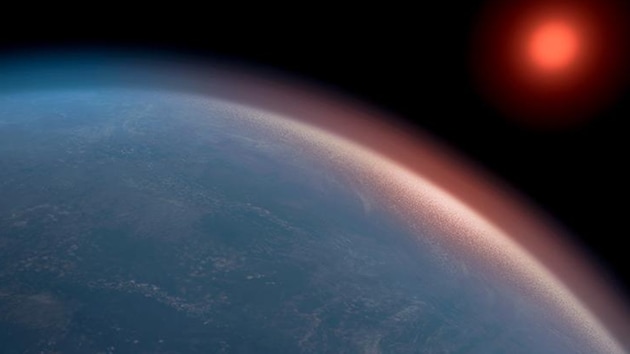
The research team led by Nikku Madhusudhan at the university’s Institute of Astronomy used the mass, radius, and atmospheric data of the exoplanet K2-18b, and determined that it is possible for the planet to host liquid water at habitable conditions beneath its hydrogen-rich atmosphere.
The results, reported in The Astrophysical Journal Letters, show that the exoplanet is 124 light-years away, and is 2.6 times the radius and 8.6 times the mass of Earth. It orbits its star within the habitable zone, where temperatures could allow liquid water to exist.
Madhusudhan said: “Water vapour has been detected in the atmospheres of a number of exoplanets but, even if the planet is in the habitable zone, that doesn’t necessarily mean there are habitable conditions on the surface.”
“To establish the prospects for habitability, it is important to obtain a unified understanding of the interior and atmospheric conditions on the planet – in particular, whether liquid water can exist beneath the atmosphere.”
{{/usCountry}}“To establish the prospects for habitability, it is important to obtain a unified understanding of the interior and atmospheric conditions on the planet – in particular, whether liquid water can exist beneath the atmosphere.”
{{/usCountry}}Given the large size of K2-18b, it has been suggested that it would be more like a smaller version of Neptune than a larger version of Earth, the university said.
A ‘mini-Neptune’ is expected to have a significant hydrogen ‘envelope’ surrounding a layer of high-pressure water, with an inner core of rock and iron. If the hydrogen envelope is too thick, the temperature and pressure at the surface of the water layer beneath would be far too great to support life.
Madhusudhan and his team have shown that despite the size of K2-18b, its hydrogen envelope is not necessarily too thick and the water layer could have the right conditions to support life.
Co-author Matthew Nixon said: “We wanted to know the thickness of the hydrogen envelope – how deep the hydrogen goes. While this is a question with multiple solutions, we’ve shown that you don’t need much hydrogen to explain all the observations together.”