At least four crew members were killed after a deck cargo ship was attacked by Yemen’s Iran-aligned Houthis in the Bab el-Mandeb Strait, two sources from the Yemeni coast guard and two military officials in the government said.
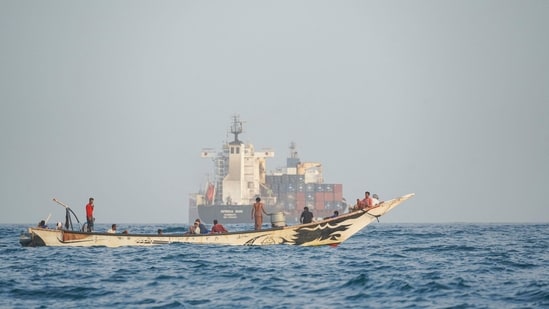
The Houthis have not yet claimed the attack, which the transportation ministry of Yemen’s internationally recognised government said killed three Pakistani nationals and an Indonesian, the Associated Press reported.
The ministry said in a statement that the Houthis fired three ballistic missiles at the Yemeni commercial vessel.
It said the rebels fired another missile that targeted rescue teams attempting to reach the vessel, wounding a Yemeni rescuer.
The attack on Tanzania-flagged Tihamah is said to be the first by a Houthi strike since the West Asia conflict was triggered by US-Israeli attacks on Iran at the end of February.
This comes a month after the Houthis declared a naval blockade against Saudi Arabia in the Red Sea in response to what they described as a Saudi siege. Riyadh denies that it had besieged Yemen, according to Reuters.
Why is Bab el-Mandeb important?
Bab al-Mandab or Bab el-Mandeb — known as ‘Gate of Tears’ over its treacherous sailing conditions has emerged as a key talking point as Strait of Hormuz continues to remain shut.
{{/usCountry}}Bab al-Mandab or Bab el-Mandeb — known as ‘Gate of Tears’ over its treacherous sailing conditions has emerged as a key talking point as Strait of Hormuz continues to remain shut.
{{/usCountry}}The Iran-backed Yemeni fighter group known as Houthis has threatened multiple times to disrupt shipping through the Bab al-Mandab strait, through which 12 per cent of global trade happens.
An average of 32 ships per day passed through the Bab el-Mandeb strait last week, Kpler data showed. Prior to the blockade an average of 50 ships per day transited the strait, as per Reuters.
The Bab el-Mandab Strait is about 30 kilometres wide at its narrowest point and lies between Yemen on the Arabian Peninsula to the northeast and Eritrea and Djibouti in Africa on the west.
Trump says US 'low-keying' talks with Iran
Amid the ongoing deadlock with Iran over the key waterway, the Strait of Hormuz, President Donald Trump said that Iran's economy was in a “very bad shape” and his administration was just going to watch the economic pressure mount amid ongoing talks to open up the Strait of Hormuz.
"We are low-keying it. We are only semi-negotiating with them. We are just watching Iran with its huge inflation and the fact they have no money," news outlet Axios quoted him as saying.
“It will work out. It always works out. It's like a chess game,” Trump asserted.
Meanwhile, Iran has denied the reports of direct negotiations with the US. Iranian Foreign Minister Abbas Aragchi said on Sunday the two sides were not engaged in talks. Tehran has been demanding that the US fulfil its side of the interim deal reached in June in order to resume direct talks. Aragchi said messages between Iran and the US were being exchanged via intermediaries.
Iran has demanded $300 billion in compensation from Washington for damage caused by the US and Israeli strikes, along with the release of up to $100 billion in frozen assets. This is one of several conditions Tehran has linked to a possible reopening of the Strait of Hormuz.
The US president rejected Iran’s demand for compensation, saying Tehran should be responsible for the deaths and injuries caused by its attacks.