
China’s remaining nine impoverished counties had eliminated extreme poverty, state media reported on Monday, marking a landmark in the country’s fight towards lifting the poorest above the poverty line.
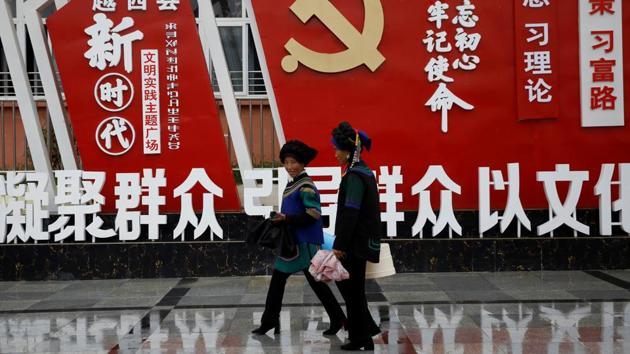
The counties, all in southwest China’s Guizhou province, had eradicated absolute poverty, the provincial government announced.
Suggested For You
“China has vowed to eradicate absolute poverty by 2020. At the end of 2019, 52 counties in the northwest, southwest and south of the country remained on the poverty list,” official Xinhua news agency said in a report.
Fighting poverty has been one of China’s three “critical” battles since 2017, the other two being curbing pollution and mitigating financial risks.
Last week, seven counties in the Liangshan Yi Autonomous Prefecture in Sichuan province were the last group of counties to be removed from the national poverty list.
Chinese government statistics say the country has lifted some 850 million out of poverty, contributing over 70% to global poverty reduction, in the last few decades.
The country’s rural poor population was slashed from 98.99 million at the end of 2012 to 5.51 million at the end of 2019, with the poverty ratio in rural regions dropping from 10.2% to 0.6%, according to government statistics.
In September, Chinese President Xi Jinping, speaking via video link at the general debate of the 75th session of the United Nations General Assembly, said that the country has every confidence it will meet the poverty eradication target set out in the 2030 Agenda for Sustainable Development, and that it will achieve that target 10 years in advance.
{{/usCountry}}In September, Chinese President Xi Jinping, speaking via video link at the general debate of the 75th session of the United Nations General Assembly, said that the country has every confidence it will meet the poverty eradication target set out in the 2030 Agenda for Sustainable Development, and that it will achieve that target 10 years in advance.
{{/usCountry}}What are the criteria for a county to be removed from the poverty list?
Broadly: “One income, two no-worries and three guarantees”
First is income. The national income standard is the constant price per capita annual income of 2,300 yuan for farmers in 2010. According to the price index, the current price was 3,218 yuan at the end of last year, and this year it is about 4,000 yuan, as per state media reports.
The two “no worries” are about food and cloths.
“Three guarantees” are compulsory education, access to basic medical care, and housing security.
Provinces, however, could have differing sets of poverty lines.
Chinese government’s own flattering statistics on poverty alleviation, however, have been questioned.
The debate over the number of poor in China was reignited last May when Premier Li Keqiang said the monthly income of some 600 million Chinese was 1000 yuan (Rs 10,000).
“It’s barely enough to cover monthly rent in a mid-sized Chinese city,” Li said at his annual press conference at the closing of China’s rubber-stamp legislature, the National People’s Congress (NPC) in Beijing.
Li’s statement assumed even more significance as it came in the backdrop of the Covid-19 pandemic, which has left the Chinese economy battered.
Explore More
ABOUT THE AUTHOR
Follow the latest breaking news, major developments and agenda-setting stories from India and around the world with the newsdesk at Hindustan Times. Operating round the clock, the desk brings together experienced editors, reporters and correspondents to deliver fast, accurate and contextual reporting across subjects that influence public policy, governance, business, society and international affairs. The HT News Desk covers politics, elections, government policies, the economy, business and markets, science and technology, the environment, law and order, infrastructure, education, climate issues and geopolitics, while closely tracking developments across states, institutions and global capitals. The team also leads coverage of major breaking news events, policy announcements, court proceedings, natural disasters, public emergencies and significant international developments. Reports published by the newsdesk are based on information gathered from reporters on the ground, official statements, government agencies, court records, regulatory filings, recognised institutions and other authoritative sources. Stories undergo editorial scrutiny and verification processes to ensure accuracy, fairness and relevance, and are updated as events evolve and additional information becomes available. Whether covering a key political decision in New Delhi, an economic policy shift affecting millions, a landmark court ruling or a major global event, the HT News Desk aims to provide readers with reliable, fact-based journalism that delivers not only the latest developments but also the context and analysis needed to understand their wider implications.