
The Solomon Islands said Wednesday it won’t allow foreign military bases on its soil, calming worries among the U.S. and allies that the country was slipping into China’s orbit and that Beijing could open a military outpost there.
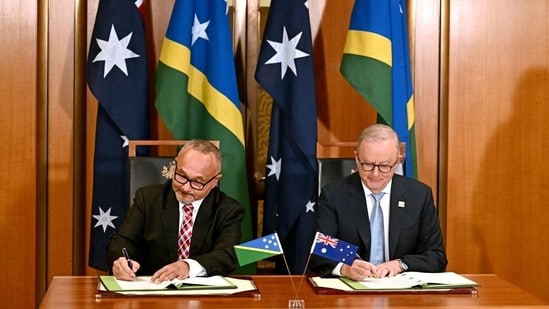
The nation of more than 800,000 people, stretched out across about 1,000 islands northeast of Australia, made the pledge in a new treaty it signed with Australia, a U.S. ally. Australia has signed several similar treaties with Pacific island states over the
Suggested For You
The Solomon Islands said Wednesday it won’t allow foreign military bases on its soil, calming worries among the U.S. and allies that the country was slipping into China’s orbit and that Beijing could open a military outpost there.
The nation of more than 800,000 people, stretched out across about 1,000 islands northeast of Australia, made the pledge in a new treaty it signed with Australia, a U.S. ally. Australia has signed several similar treaties with Pacific island states over the past two years, curbing Beijing’s efforts to increase its influence in the region.
Suggested For You
A secretive 2022 pact between the Solomon Islands and China raised fears among Western analysts that China could begin docking warships there and eventually open a military base, threatening sea links between Australia and the U.S. in a potential future conflict in the Pacific. That deal sparked a flurry of activity by the U.S. and its allies to shore up relations with remote island states that had been important battlegrounds in the Allied victory over Japan during World War II.
“Solomon Islands has been for a number of years a source of uncertainty and doubt in the region,” the country’s prime minister, Matthew Wale, said Wednesday on his visit to Australia. “Those days are done.”
During a news conference with Australian Prime Minister Anthony Albanese, Wale declined to say whether his country would formally scrap the 2022 deal with China, noting it contained a nondisclosure clause. “We have ongoing discussions with China,” he said.
China has denied that it is seeking to open a military base in the Solomon Islands. A spokesman for China’s foreign ministry said this week said this week that Beijing’s diplomacy in the Pacific was “not for geopolitical contest” and criticized efforts to thwart China’s regional engagement.
“The international community should help Pacific Island countries achieve sustainable development, respect their independence, put development first, and stick to openness and inclusiveness,” he said.
Last year, Australia signed a mutual-defense treaty with Papua New Guinea, its first military alliance since the ANZUS treaty with New Zealand and the U.S. in 1951. Pacts with Vanuatu and Fiji followed in June and July, respectively.
“Across the Pacific, we are taking our partnerships to a new level,” Albanese said.
Under the new treaty with the Solomon Islands, Australia would continue to help the country strengthen its police force, create more opportunities for Solomon Islanders to work in Australia and boost ties between the two countries through sport, culture and faith, Albanese said.
Wale, who took office in May, said he would seek to introduce legislation to “bed down the treaty,” which should make it harder for any pro-China successors to back out of the deal.
The text of the treaty was posted online by Australia’s foreign-affairs department. It says the Solomon Islands committed to keeping its sensitive infrastructure free of militarization, and it will ensure that security cooperation comes from Pacific Islands Forum members. Australia is a member of that regional group, but not China.
“Wale has sent a clear signal to Canberra and Beijing about who he wants to engage with on security moving forward,” said Connor Graham, a research fellow at the Lowy Institute think tank in Sydney.
Still, China is the Solomon Islands’ largest trading partner, making the country vulnerable to potential retaliation from Beijing, Graham said.
“The question now is can Australia deliver on whatever promises and commitments have been made to make this worth the blowback in the long term for Solomon Islands,” he said.
Write to Mike Cherney at mike.cherney@wsj.com and Austin Ramzy at austin.ramzy@wsj.com
One Subscription.
Get 360° coverage—from daily headlines
to 100 year archives.
Archives
HT App & Website