Chinese President Xi Jinping visited the Tibet Autonomous Region (TAR) this week, the first time as the country’s head, beginning his three-day tour at a strategic border city near the Sino-India boundary in Arunachal Pradesh, on Wednesday.
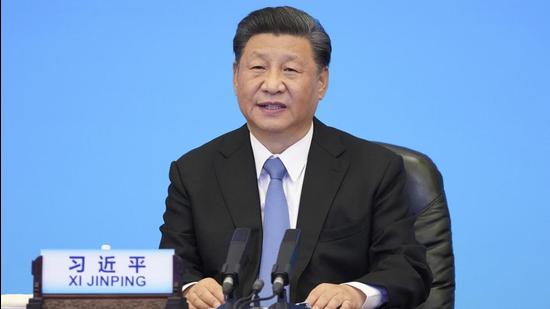
“Xi, general secretary of the CPC Central Committee, Chinese president and chairman of the Central Military Commission, visited the TAR from Wednesday to Friday for the 70th anniversary of Tibet’s peaceful liberation, the first time in the history of the party and the country,” Xinhua news agency reported.
Xi stressed fully implementing the guidelines of the Communist Party of China (CPC) for governing Tibet in a new era and writing a “…new chapter of lasting stability and high-quality development for the plateau region”.
The border visit comes in the backdrop of Beijing tightening controls over the remote Himalayan region’s traditional Buddhist culture and sinicising Buddhism with “Chinese socialist characteristics”; the twin approach along with an accelerated drive for economic development.
The Sino-India border in Tibet is of obvious strategic significance to both countries especially in the backdrop of the ongoing military standoff in eastern Ladakh area, which on the Chinese side is in the disputed Aksai Chin region.
{{/usCountry}}The Sino-India border in Tibet is of obvious strategic significance to both countries especially in the backdrop of the ongoing military standoff in eastern Ladakh area, which on the Chinese side is in the disputed Aksai Chin region.
{{/usCountry}}“Xi stressed efforts to strengthen developing border areas, emphasised the four major issues of stability, development, ecology and border-area consolidation, and called for new achievements in protecting the ecology of Qinghai-Tibet plateau and advancing its sustainable development,” Xinhua said.
This week’s visit to Tibet was a first for Xi as president and CPC general secretary; As China’s then vice-president, Xi led a delegation to Lhasa on July 18, 2011 to commemorate the 60th anniversary of “the peaceful liberation of Tibet’’.
Photos released by Xinhua showed Xi was accompanied by Zhang Youxia, a vice chairperson of China’s Central Military Commission and a senior general in the People’s Liberation Army.
It was the first time a Chinese president visited Tibet since 1990 when then leader Jiang Zemin took a tour.
Xi’s predecessor, former president Hu Jintao, who was Tibet’s CPC chief during the late 1980s, never visited the region during his 10-year presidential tenure.
TAKES STOCK OF KEY PROJECTS
During his visit, Xi inspected a number of key infrastructure projects including the Sichuan-Tibet railway project and the Lhasa-Nyingchi route, an important rail line under the project, inaugurated last month.
On Thursday, Xi took a train to Tibetan capital Lhasa on the Lhasa-Nyingchi route.
“…Xi went to Nyingchi railway station, learning about the overall design of the Sichuan-Tibet railway and the operation of the Lhasa-Nyingchi railway section, and then took a train to the regional capital Lhasa. He inspected the construction along the railway during the ride,” Xinhua reported.
The route is of strategic significance as it terminates close to the disputed border with India.
In Lhasa, Xi visited a monastery and the Potala Palace Square, and “inspected ethnic religion” and Tibetan cultural heritage protection, Xinhua reported.
The palace is the traditional home of Tibetan Buddhism’s spiritual leader, the Dalai Lama, who is in exile in India and has been branded a separatist by Beijing.
It was the second time Xi visited a Tibetan area in China in seven weeks.
In June, Xi went on a tour to northwest China’s Qinghai province, where he visited the capital city of Xining and the Haibei Tibetan Autonomous Prefecture between June 7 and 9.
It’s an important visit for Xi before the Beidaihe Conclave, an annual meeting of China’s top leaders and experts at a seaside resort near Beijing, which is usually held in August, according to India-based Tibet expert, Claude Arpi.
“He visited Tibetan areas twice in less than two months (and both time, one can hear him saying Tashi Delek),” Arpi said, citing official videos showing Xi speaking the Tibetan phrase to greet locals.
HYDROPOWER PROJECT ON YARLUNG ZANGBO
Arpi said Xi went to Nyingchi to show the importance of the new Lhasa-Nyingchi railway and probably the planned mega-hydropower project on the Yarlung Zangbo (Brahmaputra in India) besides sending the message that he cares for the remote border areas of China.
“He will be able to report that everything is fine in Tibet (to balance the western propaganda on Xinjiang),” Arpi added.
The Washington-based International Campaign for Tibet said that the visit may have been linked to the “…70th anniversary of the controversial 17 Point Agreement, which China falsely claims marks its ‘peaceful liberation of Tibet’, but which the Dalai Lama has renounced as an agreement made under duress”.
Xi’s visit to Nyingchi comes a month after China inaugurated its first electric train service in Tibet between capital Lhasa and Nyingchi city, a week before the ruling CPC celebrated its 100th birthday on July 1.
The inauguration of the new line marks a critical stage in Beijing’s long-term vision to build infrastructure in TAR and connect the remote border areas and Lhasa to interior China.
The terminus of the railway line is likely to be close to the Bayi town area, near the border with India.
“China has listed the development of border areas in the next five-year plan, and reducing the gap between western and eastern areas is also an important goal to be achieved marching towards the second centenary goal,” Lou Chunhao from the China Institutes of Contemporary International Relations, told Global Times newspaper on Friday.