The evidence of ‘subsurface lakes’ deep below the ice cap at Mars’ south pole could be due to clay, a trio of new studies have unravelled the mystery. For a long time, scientists have been probing about possible evidence of life on Mars and any evidence suggesting the presence of liquid water on the cold and dry planet tantalizes them.
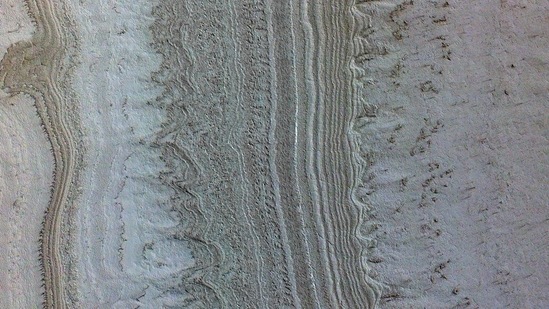
Citing evidence collected from a radar instrument aboard the European Space Agency Mars Express orbiter, a team of scientists from Italy had suggested the possibility of subsurface lakes below the ice caps at Mars’ south pole. According to Nasa, radar signals change when they are reflected off different materials.
In this case, the radar signals from the Mars Advanced Radar for Subsurface and Ionospheric Sounding, or MARSIS, produced bright signals beneath the polar cap, which, the scientists said, could be interpreted as liquid water.
Shortly after researchers from Italy’s Istituto Nazionale di Astrofisica published the paper on the lake, about 80 Martian polar scientists met for an international conference in Ushuaia, a seaside village at the southern tip of Argentina. Lots of talks centred around the subsurface lakes as they discussed the possibility of brine lowering the freezing point of the water enough to keep it liquid, said Nasa.
Jeffrey Plaut of Nasa’s Jet Propulsion Laboratory and Aditya Khuller, a doctoral student who was interning at JPL analyzed 44,000 radar echoes across 15 years of MARSIS data and turned up dozens more bright reflections similar to the 2018 study. They found many of those bright signals in areas close to the surface, where it should be too cold for water to remain liquid.
{{/usCountry}}Jeffrey Plaut of Nasa’s Jet Propulsion Laboratory and Aditya Khuller, a doctoral student who was interning at JPL analyzed 44,000 radar echoes across 15 years of MARSIS data and turned up dozens more bright reflections similar to the 2018 study. They found many of those bright signals in areas close to the surface, where it should be too cold for water to remain liquid.
{{/usCountry}}Another theoretical study conducted in a cold laboratory indicated that a group of clays called smectites, scattered in the vicinity of the south pole’s ice cap, could be the reason behind the bright signals.
While the possibility of a potentially habitable environment for microbes excited the scientists, a closer look at the data along with laboratory experiments on Earth may have dried up the lakes hypothesis. Some scientists now think clays might be creating those bright signals.
“In planetary science, we often are just inching our way closer to the truth,” Plaut, one of the scientists who travelled to the conference, said.
“The original paper didn’t prove it was water, and these new papers don’t prove it isn’t. But we try to narrow down the possibilities as much as possible in order to reach consensus,” he added.