US President Donald Trump said on Wednesday that the death of a Russian laboratory worker did not appear to be linked to a biological weapon, as concerns over fears of pneumonic plague grew amid limited information from Russian authorities.
Russia has said the worker died from pneumonia of an "undetermined" cause. However, the United States, the European Union, and the World Health Organization (WHO) have all sought more details about the case.
ALSO READ | ‘Not bragging, I settled 8 wars’: Trump renews bid for Nobel Peace Prize ahead of Friday's announcement
Deep Dive
What are the symptoms and transmission methods of pneumonic plague?
Why is there concern over the pneumonia case of the Russian lab worker?
How is the World Health Organization responding to reports about the Russian lab worker's death?
Russia's public health agency, Rospotrebnadzor, said on Wednesday that there was no risk of an epidemic spreading among the wider population.
What Trump said on plague fears in Russia
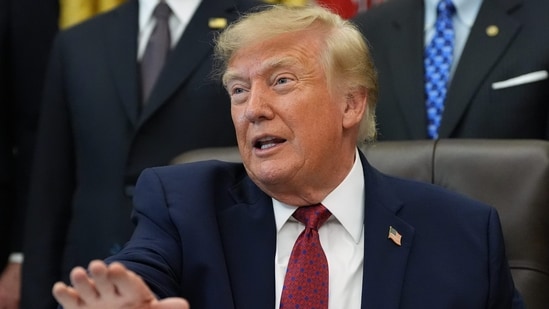
Asked in the Oval Office whether a "bioweapon" could have been involved, Trump said he did not believe that was the case. "We don't think so. We're going to find out soon enough, but we don't think so," he told reporters.
Trump said Russia maintained that the situation was under control but that authorities had shared little information publicly.
{{/usCountry}}Trump said Russia maintained that the situation was under control but that authorities had shared little information publicly.
{{/usCountry}}"If you listen to them, it's under control. But you know, people have said that before about other things," he said.
Trump compared Russia's limited public information to China's response during the early stages of the Covid pandemic. "Well, China didn't say much, and Russia is not saying much either. But they do say they have it very much under control."
He also said that he had a phone call scheduled with Russian President Vladimir Putin to discuss the issue, but did not reveal when it would take place. "Today is Vladimir Putin's birthday," Trump added.
What we know about fears of pneumonic plague in Russia
The World Health Organization said it had not yet established what caused the death of the 28-year-old woman, who worked at an anti-plague research institute. The UN health agency has asked Russia for more information and cited initial, unconfirmed reports suggesting pneumonic plague.
Notably, pneumonic plague can spread from person to person and can cause a serious form of pneumonia. However, patients have a high chance of recovery when the disease is identified and treated promptly.
The WHO said Russian authorities stated that the laboratory worker initially showed signs of a “typical” acute respiratory viral infection. They also said no recent cases of plague had been recorded. A local mayor said the hospital where the woman died had been placed under quarantine.
Russia on Wednesday warned against the spread of "false" information after reports surfaced about a second suspected plague case. Its health agency said there were "no epidemic risks for the population".
Russia told the WHO that no plague cases had been reported in the region and that people who had been in contact with the worker had been cleared. However, Maria Van Kerkhove, WHO director of Epidemic and Pandemic Management, said questions remained about the case.
The uncertainty led the WHO to reconsider its earlier statement that the risk to the wider population was low. “We are pushing on our side through the international health regulations and through all the channels that we have,” Kerkhove said. “Bear with us as we do this.”
With inputs from agencies