The Federal Aviation Administration (FAA) lifted a nationwide ground stop for US flights that halted thousands of departures for more than four hours on Friday, disrupting travel for hundreds of thousands of people.
Officials cited “extraordinary circumstances” for the ground stop, with Transportation Secretary Sean Duffy saying a communications issue affected the regional air traffic control centres that direct planes between airports nationwide.
Aircraft departures can now resume after the FAA lifted the ground stop, although the disruption is expected to last for days. Over 10,000 flights have been delayed, and another 4,000 have already been cancelled due to the outage, according to data from FlightAware.
Also Read | FAA employee explains possible cause of nationwide ground stop on flights: ‘Wouldn’t rule out cyberattack’
Deep Dive
Why did the FAA halt departures across the US?
What caused the FAA ground stop, and has the cause been confirmed?
Did the FAA's SMART AI tool cause the nationwide flight disruption?
What led to the ground stop?
The FAA grounded all departing US flights for just the second time since the 9/11 attacks in 2001, as officials cited "extraordinary circumstances" caused by communications problems at regional air traffic control centres. The agency described the problem as "a temporary telecommunications outage" and said it was acting "out of an abundance of caution."
{{/usCountry}}The FAA grounded all departing US flights for just the second time since the 9/11 attacks in 2001, as officials cited "extraordinary circumstances" caused by communications problems at regional air traffic control centres. The agency described the problem as "a temporary telecommunications outage" and said it was acting "out of an abundance of caution."
{{/usCountry}}The outage appeared to be affecting a telecommunications network overseen by L3Harris Technologies, which handles crucial radio frequencies that air-traffic controllers use to communicate with pilots, according to a Wall Street Journal report. It was not clear whether the outage had affected the radar feeds used to keep aircraft safely separated during flights.
However, Homeland Security Secretary Markwayne Mullin said there was no sign of a threat to the United States and "this isn't another 9/11."
"There was no indication, as of yet, that this was a nefarious attack against us, it's just a telecommunication outage, as of right now," he said at a briefing, adding that officials had not ruled out anything at the point.
With thousands of flights hit by the ground stop, reports warned that disruptions are likely to grow in the coming days. Airlines started scrubbing weekend flights, with more than 300 cancelled on Saturday, and crew members were unsure what to do next, according to WSJ.
Also Read | Trump says ageing aviation system likely behind FAA ground stop, not cyberattack
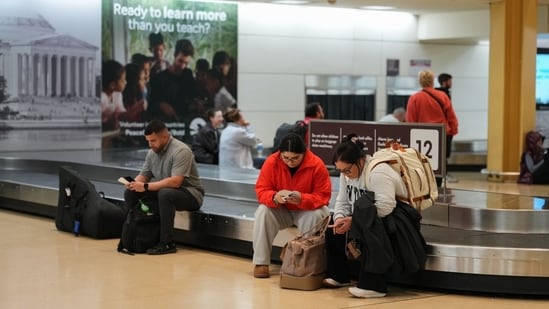
The ground stop triggered chaos at several major airports, with thousands of people being stuck in queues while anxiously waiting for more updates on the situation. Over 1.5 million people were scheduled to fly on flights after the pause took effect, according to aviation data firm Cirium.
Officials rule out cyberattack
Meanwhile, Markwayne Mullin said there is no indication of a cyberattack. "There were never any lives at risk. There were no flights at risk. FAA was able to handle it," he said.
Transportation secretary Duffy blamed an "incredibly old" US air traffic control system, which he said relied on an analogue system that got overloaded with data. He said the Trump administration had been “asking Congress to fully fund a full build of a brand new air traffic control system.”
"This is an emergency," he said, calling on Congress for emergency funding for upgrades. Last year, Congress gave the Transportation Department $12.5 billion to start upgrading the nation’s air traffic control infrastructure, but some lawmakers have questioned about how the FAA has managed the funds, according to The New York Times.