
 E-Paper



Fed up with Putin, Trump offers Ukraine arms and tariffs
America will supply air-defence missiles and may punish countries that trade with Russia


 Prefer HTon Google


AFTER HIS first post-election call with Vladimir Putin in February, Donald Trump gushed about the “great benefits” of a rapprochement with Russia and seemed to relish the prospect of visiting the Kremlin. On July 14th he lost patience, announcing that America would resume supplies of Patriot air-defence missiles and other weapons, and threatening secondary tariffs of 100% on countries doing business with Russia if there was no peace deal within 50 days. “We’re very unhappy with Russia,” Mr Trump declared.
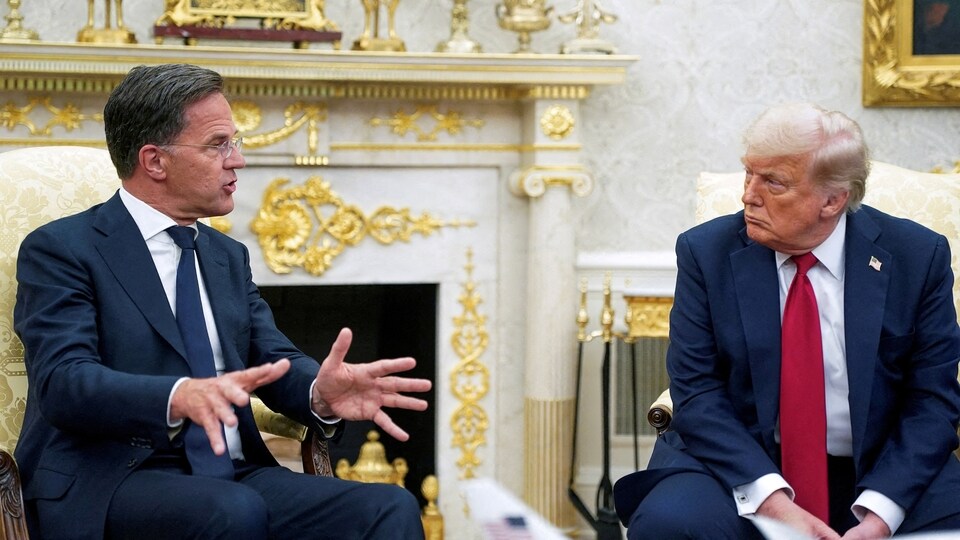
The announcement came during a visit to Washington by Mark Rutte, NATO’s secretary-general. America’s president praised European countries for spending more on defence. But there was, as always, a Trumpian twist. The weapons for Ukraine would henceforth be bought by European allies rather than donated from American stocks or bought from manufacturers with American money, as in the past. Billions of dollars’-worth of funds authorised by Congress under his predecessor, Joe Biden, remain unused, but Mr Trump seems unlikely to touch it. “It wasn’t my war; it was Biden’s war.”
In Ukraine, relief that the flow of weapons would restart mixed with concern at the 50-day delay in imposing economic penalties, which comes after Mr Trump repeatedly gave Russia two weeks to reach a deal. Oleksandr Merezhko, a prominent member of the parliamentary party of Volodymyr Zelensky, Ukraine’s president, hailed the “good news”. But he cautioned that “these 50 days might be dangerous for us, because Putin will definitely use it” to press his attacks. Oil markets seemed unmoved by the threat of tariffs, even though they could potentially hit countries such as China, India and Brazil. That suggests scepticism that they will ever be applied.
A separate bipartisan bill threatening 500% secondary tariffs, supported by more than 80 senators, may now make progress in Congress. But it too gives Mr Trump wide discretion in imposing or waiving penalties. Mr Trump sees tariffs as a means to achieve an array of goals, from raising revenues at home to ending wars abroad, but has been endlessly variable in his decision-making, repeatedly announcing imposts only to negotiate their partial removal. How Mr Trump might co-ordinate such new tariffs with his wider trade war remains to be seen; it would seem to clash with his on-again, off-again efforts to draw India into a partnership against China.
As for weapons, on the face of it Mr Trump’s announcement seems to assure Ukraine of a steady flow of kit that only America can provide, such as the Patriot system to shoot down ballistic and cruise missiles. It comes just as the flow from Mr Biden’s commitments of military assistance is petering out. But Mr Trump did not say how many Patriot batteries and interceptors America would make available. Air-defence systems have been in short supply globally, not least because America expended many interceptors in helping to defend Israel and Qatar from Iranian missiles during the 12-day Israel-Iran war. Indeed, in June the Pentagon briefly suspended the delivery of Patriot interceptors and other weapons to Ukraine, supposedly pending review of American stocks (though no such suspension was made for Israel). It was soon countermanded by Mr Trump.
Nor did Mr Trump say what other weapons America would provide. There have been unconfirmed reports that they might include deep-strike weapons able to reach Moscow. Mr Biden supplied ATACM missiles with a range of about 300 kilometres. To reach Moscow, some 500 kilometres away, Ukraine would need either the Tomahawk cruise missile or the stealthier JASSM-ER (with ranges of about 800 to 1,500 kilometres or more, depending on the variants). Whether Mr Trump would risk such escalation, even by notionally selling them to European countries rather than directly to Ukraine, is open to question. In any case, long-range ground-attack weapons are also in short supply.
In short, doubts abound. The military assistance may not be enough to halt the slow, grinding advance of Russian forces in eastern Ukraine. Attitudes to Ukraine remain lukewarm, if not hostile, among Mr Trump’s MAGA devotees and in parts of his administration. Mr Trump declined to answer questions about what he would do if Russia intensified its attacks. Russia seems able to endure bloody operations for some time to come, short of a domestic political or economic crisis that threatens Mr Putin. There is little evidence that Russia’s leader is ready to abandon his underlying objectives: the annexation of more Ukrainian territory, and what he terms dealing with the “root causes of the conflict”. That is Kremlin-speak for imposing neutrality on Ukraine or re-absorbing it into Russia’s sphere of influence.
Mr Trump might U-turn again—if, for example, he is frightened by Mr Putin’s nuclear threats, seduced by a promise of flexibility in talks, or grows fed up with the military stalemate. Even so, he seems to be on a long journey in his thinking about Russia. In February he publicly humiliated Mr Zelensky during a visit to the White House, and for a time cut off the flow of weapons and intelligence. In April he began to wonder whether Mr Putin was ”tapping me along”, and threatened sanctions, but repeatedly gave Russia the benefit of the doubt.
Months of diplomatic patience by Ukraine, much flattery by European allies (notably Mr Rutte), quiet exhortation by congressional hawks, and above all obduracy from Mr Putin all contributed to Mr Trump’s apparent change of heart. “For six months President Trump tried to entice Putin to the table. The attacks have gone up not down,” explained Lindsey Graham, a hawkish senator, on CBS television on the eve of Mr Trump’s announcement. “One of the biggest miscalculations Putin has made is to play Trump.” The president once mocked Mr Zelensky for having “no cards”. Now he has decided to slip him a few new ones—at least for a time.


