The Palm Springs house of Frank Sinatra was initially constructed as a retreat for him in the early years of his ascension to Hollywood stardom. The house, which is called Twin Palms, was constructed in 1947 at the cost of $150,000 and became famous throughout California as a representative example of mid-century modern architecture. It reflected a shift in American housing architecture after the end of the Second World War. The house incorporated luxury into its design and blended with the surrounding desert environment.
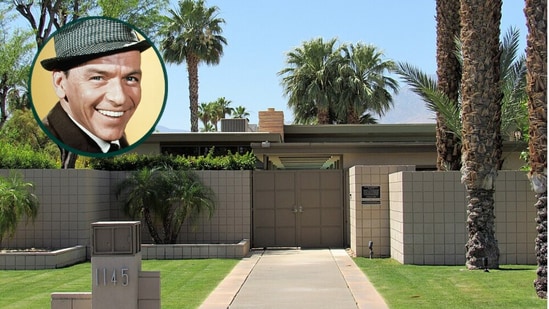
According to the Palm Springs Preservation Foundation, architect E. Stewart Williams designed the house at 1148 East Alejo Road in Palm Springs. What began as a celebrity’s desire for a private family residence eventually became an architectural landmark, attracting visitors interested in Sinatra's life and the development of modernist design in the American West.
From a Hollywood ambition to a desert retreat
The house was commissioned by Sinatra in 1947, when he was rising to fame as an entertainer. On signing a profitable contract to appear in a film with Metro-Goldwyn-Mayer, he needed a place to spend the weekends with his family out of the bustling life in Hollywood. At first, he was attracted to the idea of building an authentic Georgian-style house, with a brick exterior and columns. But Williams, who had just started working on his first project in Palm Springs, came up with a different solution. He offered a design suited to the desert climate.
Eventually the architect's plans succeeded in persuading the famous singer. Sinatra spent $150,000 on this project, and its construction commenced amid tight deadlines. He desired his house to be ready by the time of a Christmas party, which left Williams and his construction crew with not much time before they had to build this house. This resulted in the completion of a house which was named Twin Palms due to two large palms planted near the swimming pool.
Architecture that reflected the Palm Springs lifestyle
{{/usCountry}}Eventually the architect's plans succeeded in persuading the famous singer. Sinatra spent $150,000 on this project, and its construction commenced amid tight deadlines. He desired his house to be ready by the time of a Christmas party, which left Williams and his construction crew with not much time before they had to build this house. This resulted in the completion of a house which was named Twin Palms due to two large palms planted near the swimming pool.
Architecture that reflected the Palm Springs lifestyle
{{/usCountry}}Designing Twin Palms, the architect Williams used desert modernism, an architectural style that focuses on simplicity, natural materials, interioropenness, and a close relationship between building and nature. He did not use any fancy decoration but instead used the surrounding light and outdoor area to describe the house. The design had low horizontal components, a flat floor, and a big glass door with window panes linking the indoor and outdoor surroundings. The sloping ceiling was done using Douglas fir, while the Arizona flagstones were used for the chimneys. The redwood also enhanced the natural look of the building.
One of the house's distinctive feature was a swimming pool in the form of a grand piano. Built near the living room, it represented Sinatra's desire to entertain his visitors. Another special feature of the house was the pergola and cabana, which provided an open-air setting, appropriate for Palm Springs’ climate. The house was not just a lavish celebrity home; it also exemplified a new architectural approach in postwar America.
Research published in the Journal of Urban Cultural Studies examines the role of modernist architecture in shaping Palm Springs' cultural identity and the efforts to preserve its architectural heritage. While the study considers the city's broader architectural history, Twin Palms offers a specific example of this development. Designed by E. Stewart Williams, the residence was an early project in his career, which later included several buildings that helped shape Palm Springs' distinctive architectural character.
Historic recognition and the preservation of Twin Palms
Despite being built in 1947, Twin Palms did not gain historical status until sixty four years. This honor was sought by the Palm Springs Preservation Foundation in 2010 on behalf of the owners of that period, Tom and Marianne O’ Connell. The city's Historic Site Preservation Board reviewed the proposal and recommended approval in February 2011. On March 16, 2011, the Palm Spring City Council unanimously listed the residence as a Class I historic site. A recognition ceremony followed in October that year.
The designation was important as it provided protection to the architecture of the property. Any future changes to the property would have to be reviewed by the historic site preservation board in the city in order to avoid any changes that might jeopardize the features that made the property historically important. This designation went on to receive further recognition. In December 2016, the Frank Sinatra house was added to the National Register of Historic Places as a recognition of architect E. Stewart Williams's work.
Preservation of Twin Palms is also a part of a broader attempt to preserve the architectural heritage during the middle decades of the 20th century. The house once owned by Sinatra deserves special attention because it is not only a distinctive example of architectural design but is also linked to his personal life. Today, it serves as an example of how a residence designed for the comfort and entertainment of its owner can become something much more important.