The Latin America and the Caribbean region remained the global epicentre, accounting for almost one-third of all deaths and housing two of the worst-affected countries - Mexico and Brazil.
he global death toll from Covid-19 passed 750,000 on Thursday, with some countries toughening controls as caseloads once again creep up.
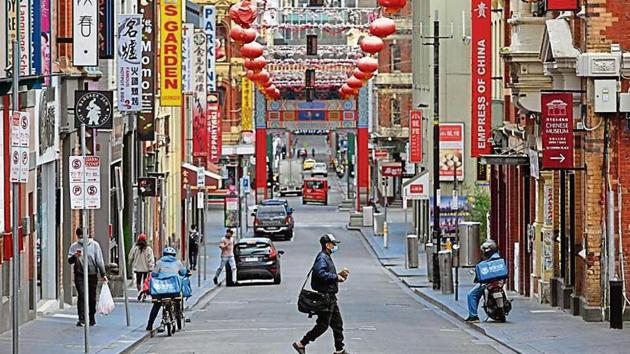
A man crosses a quiet road in Melbourne’s Chinatown area on Thursday. (AFP)
The Latin America and the Caribbean region remained the global epicentre, accounting for almost one-third of all deaths and housing two of the worst-affected countries - Mexico and Brazil. Fear is growing in other regions, with countries including New Zealand and Italy tightening measures in a bid to secure hard-won gains in fighting the virus, which has now infected more than 20 million worldwide.
{{^htLoading}} {{/htLoading}}
{{^usCountry}}{{/usCountry}}
New Zealand, which earlier this week broke a streak of more than 100 days without a new infection, is scrambling to find the source of 17 new cases in its biggest city Auckland - which faces the prospect of a three-day lockdown being extended.
People living in London and those of Indian and Asian background are most likely to have been infected by the coronavirus, a key study by Imperial College London published on Thursday said, adding that 6% of England’s population has been infected so far. The 6% reflects about 3.4 million people. Over 100,000 volunteers took part in the study. Billed as the “world’s largest home antibody testing programme for coronavirus”, it tracked infections across England after the first peak.
Follow the latest breaking news, major developments and agenda-setting stories from India and around the world with the newsdesk at Hindustan Times. Operating round the clock, the desk brings together experienced editors, reporters and correspondents to deliver fast, accurate and contextual reporting across subjects that influence public policy, governance, business, society and international affairs. The HT News Desk covers politics, elections, government policies, the economy, business and markets, science and technology, the environment, law and order, infrastructure, education, climate issues and geopolitics, while closely tracking developments across states, institutions and global capitals. The team also leads coverage of major breaking news events, policy announcements, court proceedings, natural disasters, public emergencies and significant international developments. Reports published by the newsdesk are based on information gathered from reporters on the ground, official statements, government agencies, court records, regulatory filings, recognised institutions and other authoritative sources. Stories undergo editorial scrutiny and verification processes to ensure accuracy, fairness and relevance, and are updated as events evolve and additional information becomes available. Whether covering a key political decision in New Delhi, an economic policy shift affecting millions, a landmark court ruling or a major global event, the HT News Desk aims to provide readers with reliable, fact-based journalism that delivers not only the latest developments but also the context and analysis needed to understand their wider implications.
Get the latest World News, breaking headlines, and real-time coverage from key global hotspots, including the US News, Russia, Ukraine, Iran News, and the UAE News. Track developing conflicts, high-stakes diplomacy, and major international events on Hindustan Times.
Get the latest World News, breaking headlines, and real-time coverage from key global hotspots, including the US News, Russia, Ukraine, Iran News, and the UAE News. Track developing conflicts, high-stakes diplomacy, and major international events on Hindustan Times.