
SEQUIM, WASH.—The dashboard on my Kia Niro rental flashed a warning about 40 miles from Lake Crescent.
The gist: Charge up soon or you won’t make it to your destination. This despite the gauge showing a battery range of 110 miles.
It was my unsettling introduction to electric-vehicle range anxiety. My plans for sunset in an Adirondack chair at Lake Crescent Lodge were looking dicey.
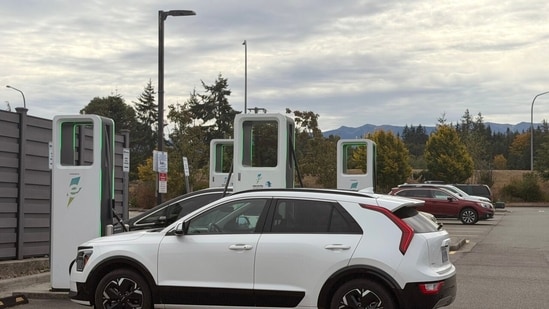
It all worked out thanks to a charging station at a Walmart in Port Angeles
SEQUIM, WASH.—The dashboard on my Kia Niro rental flashed a warning about 40 miles from Lake Crescent.
The gist: Charge up soon or you won’t make it to your destination. This despite the gauge showing a battery range of 110 miles.
It was my unsettling introduction to electric-vehicle range anxiety. My plans for sunset in an Adirondack chair at Lake Crescent Lodge were looking dicey.
It all worked out thanks to a charging station at a Walmart in Port Angeles and the kindness of a stranger. A local coffee shop and bakery owner was charging his electric Cadillac in the next spot and showed me how to charge my car. (I was such an EV newbie that I hauled the home-charging unit from the trunk thinking I somehow needed it.) And I got to pet his St. Bernard, Romulus, while we waited.
Electric vehicles aren’t exactly having a moment. Sales are down sharply and car-rental companies like Hertz that bet big on them have dramatically shrunk their EV fleets due to lackluster demand.
Stubbornly high gas prices might be a salve, though. Car-rental deals site AutoSlash has seen an 18% increase in EV interest since the war with Iran began in February.
So I set out to see if renting an EV is a solid money-saving option for the novices among us or a time-wasting headache that spoils a road trip.
I paid $370 including taxes and fees for a four-day, electric-vehicle rental from Budget to travel 500 miles around the Olympic Peninsula from Seattle. The only cheaper vehicle option was a pickup truck at $350; a gas-powered economy car was $430, a regular SUV $477.
Full disclosure: I didn’t study up before the road trip except to scout charging locations. I wanted to see how things would unfold for a newbie.
The Budget rep at Seattle-Tacoma International Airport wasn’t any help. He didn’t say what the charge level was or what it needed to be upon return or even mention I had an EV. He simply handed me the keys and spot number.
The dashboard was foreign but vaguely familiar with a battery gauge instead of a fuel gauge. The car showed a range of 185 miles when I left the airport. The trip to Lake Crescent in Olympic National Park, which included a ferry ride from downtown Seattle, was about 115 miles.
By my calculations, with confirmation from chatbot Gemini, I could make it to the lodge without a charging stop. The hotel has two complimentary chargers in a parking lot.
Those plans were thwarted by the car’s warning message. (I’ve since learned the warning likely stemmed from a previous renter’s navigation settings.) With sunset looming, I charged the car from 44% to 72%. It took about 30 minutes.
The station promised hyper speeds, but I learned the high-end range applies to high-end cars, not my Kia Niro. The tab from Electrify America: $10.58. The Safeway gas station down the road was charging $5.55 a gallon for unleaded.
Not all charging downtime is spent roaming the Walmart snack aisles. The second morning of the trip, I had time for a leisurely lakefront breakfast, one-hour hike, sightseeing tips from a lodge employee and packing while the Kia charged to 100%. It took 4 ½ hours.
It was a smart move given the long drive ahead. I was headed to Cape Flattery, the northwesternmost point in the contiguous U.S., and La Push on the Pacific Ocean, my home for the night.
By the time I pulled into Forks, Wash., home of the Twilight series, my range was down to 108 miles. The plan was to get a little juice and then charge overnight at the oceanfront resort 16 miles away.
Two major problems emerged, one of which had me up most of the night.
There’s a row of Tesla chargers outside the Dew Drop Inn motel. But I hadn’t downloaded the Tesla app to access the magic adapter the Kia needed to charge there. The hotel nicely let me use their Wi-Fi to download it, but even that didn’t work.
My research said the nearby Quileute Oceanside Resort had two chargers like the Lake Crescent Lodge. Turns out, a resort with a similar sounding name has EV chargers, but Quileute doesn’t. (Nor does it have Wi-Fi except in a couple select spots.)
Enter panic mode. I had a 3 ½- to 4-hour drive from the resort to Seattle early the next morning and the battery range was 108 miles. The best charging option: the aforementioned Tesla chargers at the Dew Drop Inn.
This time, a miracle. I was able to download the Tesla app in the tiny resort lobby the night before (“Go by the window for better reception”). It worked after I figured out all the Kia model specifics it required.
The next morning the app allowed me to unlock an adapter on the charger so the Tesla station would work with my Kia. I was irrationally proud. The best part of the 90-minute pit stop to charge the car to 93% besides the $21.88 price: cheap lattes and bathrooms at the Thriftway supermarket across the street.
A few hours and one more Walmart charge later, I seriously considered returning the car to Budget early so I didn’t have to worry about charging or driving anymore.
I kept it, charging overnight at my next hotel with ease. The total charging tab for the entire trip: $57.19.
Would an EV be my first pick on my next road trip? Probably not, especially if I was pressed for time. Still, it was a smooth ride and less stressful overall than I expected. So an EV could make sense at the right price.
And, no matter what way you get there, go visit the stunning Olympic Peninsula.
Write to Dawn Gilbertson at dawn.gilbertson@wsj.com
One Subscription.
Get 360° coverage—from daily headlines
to 100 year archives.
Archives
HT App & Website