
 E-Paper



India, Australia to hold key trilateral meetings in April, Indo-Pacific on agenda
These meetings are expected to focus on issues such as maritime security and collaborating on shared challenges across the region. France is seen as a natural fit for working with the Quad as it has 1.5 million citizens on island territories within the Indo-Pacific.

 Prefer HTon Google


Members of the Quad are moving forward with their agenda for ensuring a free and open Indo-Pacific by working with other like-minded countries, with India and Australia set to hold two key trilateral ministerial meetings in New Delhi next month.
External affairs minister S Jaishankar and Australian foreign minister Marise Payne will hold separate meetings with their French counterpart Jean-Yves Le Drian and Indonesian counterpart Retno Marsudi on the margins of the annual Raisina Dialogue during April 13-15, people familiar with developments said on condition of anonymity.
These meetings are expected to focus on issues such as maritime security and collaborating on shared challenges across the region, the people said. France is seen as a natural fit for working with the Quad as it has 1.5 million citizens on island territories within the Indo-Pacific, and 93% its exclusive economic zone (EEZ) of more than 11 million sq km is also within the region.
Work on arranging the India-Australia-Indonesia trilateral has been on for more than six months but the meeting was held up because of Jakarta’s sensitivities, one of the people cited above said. The French foreign minister is among the speakers at Raisina Dialogue and the Indonesian foreign minister too is expected to attend the event, a second person said.
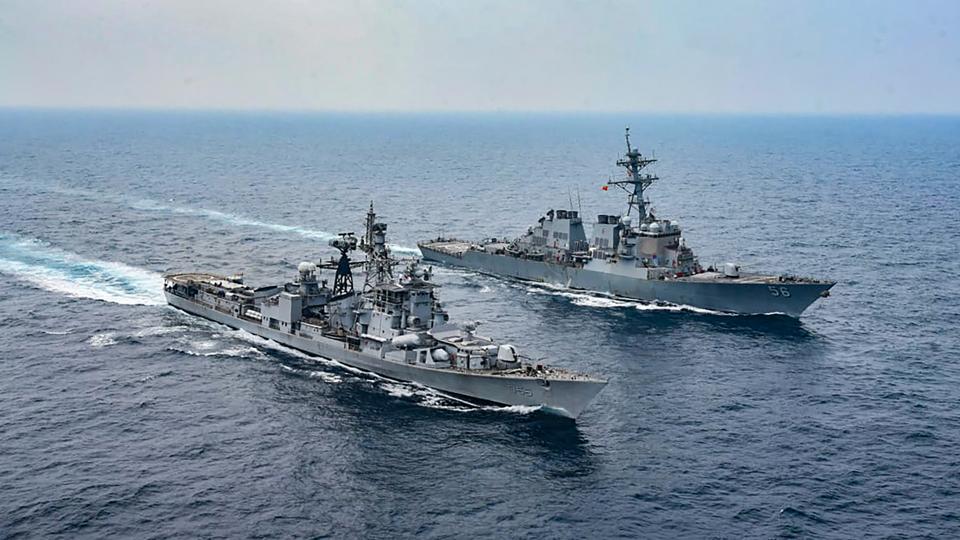
The trilateral meetings will follow close on the heels of the La Pérouse exercise in the Bay of Bengal during April 4-7, which will see the French Navy joining the navies of India, Australia, Japan and the US – the four members of the Quadrilateral Security Dialogue or Quad.
India will deploy frontline warships and P-8I maritime patrol aircraft for what is being dubbed as a “Quad-plus France” manoeuvre, and the five countries will showcase their naval strength and commitment to freedom of navigation by practising complex drills.
At the same time, work has begun on implementing the Quad Vaccine Partnership, which was seen as the most significant outcome of the first virtual Quad leaders’ summit on March 12 and envisages the production of one billion doses of Covid-19 vaccines by the end of 2022 for developing countries. The people said the Quad members are keen on production of vaccines beginning at Indian facilities as early as the second quarter of 2021 though several issues are still being addressed by the four countries.
Under the partnership, vaccines developed by the US will be made in India with funding from the US and Japan, while Australia will provide “last mile” delivery support with focus on Southeast Asia.
“A lot depends on India’s manufacturing capacity, given the demands on Indian manufacturers to fulfil both the demands of the domestic inoculation programme and commercial supplies and grants for foreign countries,” the first person cited above said.
“There could be issues such as intellectual property rights but they can be addressed by the four countries working together,” the person added.
In a media briefing after the Quad Summit, foreign secretary Harsh Shringla had said a “bridging arrangement” will be needed for manufacturing US-developed vaccines in India, including trials, tests and authorisation for doses to be certified as fit for export. This issue is being looked at by the Quad vaccine experts group, one of three working groups formed during the summit.
It is believed the four members of Quad are keen on progress on vaccines before the leaders hold their first in-person meeting. Efforts are currently on to schedule this meeting on the margins of the G7 Summit to be hosted by the UK in June. Prime Minister Narendra Modi has been invited to the G7 Summit.
Australia was chosen for logistics support for vaccine delivery as it has already created an extensive network with an existing commitment of $407 million for regional vaccine access and health security to Pacific Island countries. Australia will contribute an additional $77 million for providing vaccines and delivery support in Southeast Asia.
The other crucial working group formed during the Quad summit – the critical and emerging technology working group – will focus on collaboration on issues such as 5G, quantum computing, artificial intelligence and cyber-security. This will include both setting of standards and ensuring such cutting edge technologies aren’t misused by state actors, the people said.
“We’ve seen how such technologies can be misused during the US presidential elections and the effort will be to prevent such activities,” the first person cited above said.
The issue of rare earth metals too figured at the Quad Summit, and Australia, which has the world’s sixth largest reserves of these materials, is working closely with India and US to address China’s dominance in supplying these critical elements to makers of everything from smartphones to high-performance motors and batteries for electric vehicles.
Rare earths are critical for India’s plans to become a leader in electric vehicles and Australia will soon conduct a demand-supply assessment for India, after having completed a similar exercise for the US, the people said.
Though the joint statement issued after the Quad Summit made no direct reference to China, the people acknowledged that the impact of China’s assertive actions in the area ranging from the East and South China Seas to the Line of Actual Control (LAC) figured prominently in the deliberations by the four leaders. US President Joe Biden set the tone for these discussions with his unusually candid observations on China, the people added.
Immediately after the Quad Summit, another person familiar with the deliberations had said that the four leaders discussed India’s military standoff with China along the LAC, and the three other members had a “sympathetic view” towards New Delhi on the issue.
Former ambassador Rajiv Bhatia, distinguished fellow for foreign policy studies at Gateway House, said the eventual outcome of the ongoing meeting of senior US-China officials in Alaska could have an impact on the workings of the Quad.
“Quad’s future, which seemed bright after the summit, will partly depend on eventual dynamics between the US and China. It is still early days and the first session of the meeting in Alaska didn’t go well. The outcome is awaited,” he said.
“Within Asean, privately the governments are reportedly happy with the Quad’s vaccine initiative as there is a deficit in access to vaccines and a trust deficit where Chinese vaccines are concerned. So they are interested in the vaccine partnership, but there are also some critics and dissenters, who are looking negatively at the vaccine initiative,” he added.


