Modi government baiters were fast on the draw when they pointed to the perceived growing relevance of India’s western neighbour Pakistan in global affairs, with de facto ruler Asim Munir mediating on behalf of President Donald Trump with Iran and the US leader backing the Mecca defence pact between Islamabad, Ankara and Riyadh on August 7, 2026.
Six months into the Iran war, Tehran is still firing optically guided ballistic missiles at Gulf allies of the US and its proxies—the Houthis in Yemen and Kataib Hezbollah in Iraq—playing havoc with Saudi Arabia’s energy security architecture by hitting its East-West pipelines, airbases and key cities.
Also Read I Saudi Arabia issues emergency alert for several cities for 'potential danger' amid Houthi conflict
Gulf countries forced to fend for themselves
After keeping quiet for nearly six months, the Shia Houthis have opened another front with Saudi Arabia even as they have captured key islands off Bab el-Mandeb, the mouth of the Red Sea and a route to the Suez Canal. By doing this, Iran and its proxies have endangered both the Strait of Hormuz (Persian Gulf) and the Suez Canal route for the evacuation of crude oil and gas from the Gulf countries. And to cap it all, there are no signs of the Iran-US-Israel war ending before the US midterm elections in November.
While the Gulf countries are forced to fend for themselves against Iranian ballistic missiles and armed drones, with US munition stockpiles touching rock bottom, Tehran seems in no mood to give up the fight with the US despite the American naval blockade causing a severe economic crisis in the Shia nation. Pakistan Field Marshal Asim Munir visited Tehran on August 24 to revive the stalled peace dialogue, but to date, no concrete result can be seen.
{{/usCountry}}While the Gulf countries are forced to fend for themselves against Iranian ballistic missiles and armed drones, with US munition stockpiles touching rock bottom, Tehran seems in no mood to give up the fight with the US despite the American naval blockade causing a severe economic crisis in the Shia nation. Pakistan Field Marshal Asim Munir visited Tehran on August 24 to revive the stalled peace dialogue, but to date, no concrete result can be seen.
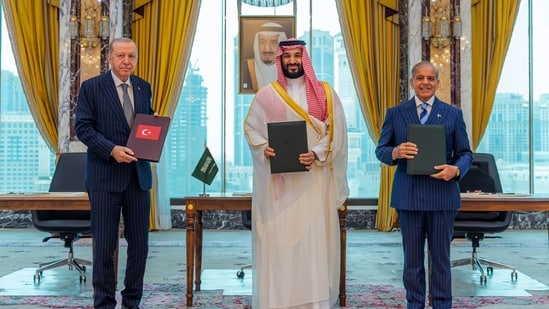
{{/usCountry}}The Mecca alliance, signed by Crown Prince Mohammed bin Salman, Recep Erdogan and Shehbaz Sharif, has been challenged by the Shia Houthis and Iraqis, with neither Turkey nor Islamabad coming to the military aid of missile-hit Saudi Arabia. The Mecca pact explicitly states that a military attack on one partner will be construed as an attack on the alliance and responded to in kind against the enemy.
“Only looks good on paper”
More than a month after the Mecca pact was signed, the so-called Sunni NATO appears to be underdeveloped in terms of standard operating procedures and doctrines, as well as oversold by the partner countries to bolster the morale of the Sunni brothers. Even though countries that have traditionally been adversaries of these three partners have started taking countermeasures, the future of this Sunni NATO appears foggy, with Pakistan and Turkey’s economies in dire straits and the Saudis already in the US debt-bond market.
Since Islamic religious scriptures call those Muslims who target fellow Muslims “Takfiris”, the alliance may take comfort in the fact that Sunnis consider Shias and others non-believers, and hence legitimate targets.
Even though the Mecca alliance partners have resisted expanding the pact to interested countries like Bangladesh, past Gulf allies like the UAE have kept out of the tri-nation military pact, as it is part of the Abraham Accords as well as a very close ally of the US to the west, India to the east and Israel as a backroom partner. Given that the internal security situation in Pakistan is bad, with active insurgencies in Balochistan and Khyber Pakhtunkhwa, and its external situation equally bad on both the western and eastern fronts, Rawalpindi is hardly in any position to come out in support of Saudi Arabia or Turkey on the ground.
Also Read I Pakistan in 'complete solidarity' with Saudi Arabia after Houthi attacks, Sharif dials crown prince Salman
Saudi Arabia also had to bite the dust as US President Trump, as per media reports, refused to act against the Houthis despite requests from the Crown Prince. Turkey’s fortunes have also dwindled, with tourism taking a hit on the economy and countries like Cyprus, Greece and Armenia looking towards India for the supply of BrahMos supersonic cruise missiles. Perhaps supporters of Pakistan in West Asia and India should think again, as the Mecca alliance, like Iran peace, only looks good on paper.