
Japanese Prime Minister Shinzo Abe donated 1 million yen ($9,000) through his wife for a school run by ultranationalist educators, the group’s leader told Parliament on Thursday, while also suggesting a land-buying scandal involving the school had “political influence” behind it.
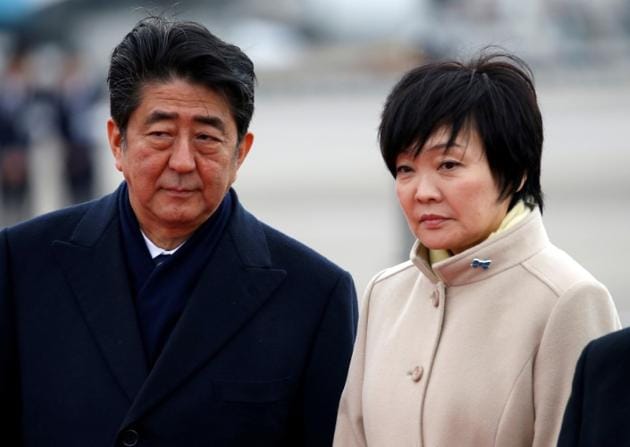
First lady Akie Abe had been honorary principal of the elementary school for several months until resigning two weeks after the scandal erupted in early February.
Suggested For You
In his sworn testimony in Parliament, Yasunori Kagoike, head of the Moritomo Gakuen group, said Akie Abe handed him the cash in an envelope on behalf of her husband during her September 2015 visit to Kagoike’s kindergarten in Osaka.
Abe has denied such a donation took place, but it would have been legal under Japanese law because Osaka is not Abe’s electoral constituency, which is in Yamaguchi in southern Japan.
Still, Abe and his wife’s ties to Kagoike have raised questions due to his extreme views on history and derogatory expressions about Chinese and Koreans, and the land-buying scandal involving the school has eroded Abe’s support in opinion polls.
Kagoike’s school is known for a curriculum that is seen as resembling that of pre-World War II militaristic Japan. And Kagoike is affiliated with the powerful political lobby Nippon Kaigi, which is believed to be behind Abe’s comeback in 2012 and has become influential in pushing Abe’s ultra-conservative platform.
{{/usCountry}}Kagoike’s school is known for a curriculum that is seen as resembling that of pre-World War II militaristic Japan. And Kagoike is affiliated with the powerful political lobby Nippon Kaigi, which is believed to be behind Abe’s comeback in 2012 and has become influential in pushing Abe’s ultra-conservative platform.
{{/usCountry}}Abe had spoken fondly about Kagoike’s education policies but has distanced himself from the man, criticizing him for being too persistent.
Kagoike said he is revealing the truth about Abe, who he thought was supportive before brushing him off once the scandal emerged. He said both Abes have kept close ties to him and Akie has exchanged dozens of text messages with his wife despite the scandal.
Abe has denied any influence in the sale last year of state property to Kagoike at 134 million yen ($1.2 million), one-seventh of its appraised price.
But Kagoike told parliament he believed there was “political influence” over his land purchase and a plan to open an elementary school. “I believe there was political influence one way or the other at every occasion and place (during approval process),” Kagoike said, without elaborating.
The school project advanced rapidly through the licensing process but has fallen apart, Kagoike said, and he is seen as the bad guy, as if he had been framed. He urged lawmakers to question Akie, her assistant and finance ministry bureaucrats to clarify their responsibility in the land purchase.
Chief cabinet secretary Yoshihide Suga on Thursday reiterated his and Abe’s denial over the alleged donation or any other political influence over Moritomo Gakuen’s licensing for its elementary school, where construction is almost complete.
Explore More
ABOUT THE AUTHOR
Follow the latest breaking news, major developments and agenda-setting stories from India and around the world with the newsdesk at Hindustan Times. Operating round the clock, the desk brings together experienced editors, reporters and correspondents to deliver fast, accurate and contextual reporting across subjects that influence public policy, governance, business, society and international affairs. The HT News Desk covers politics, elections, government policies, the economy, business and markets, science and technology, the environment, law and order, infrastructure, education, climate issues and geopolitics, while closely tracking developments across states, institutions and global capitals. The team also leads coverage of major breaking news events, policy announcements, court proceedings, natural disasters, public emergencies and significant international developments. Reports published by the newsdesk are based on information gathered from reporters on the ground, official statements, government agencies, court records, regulatory filings, recognised institutions and other authoritative sources. Stories undergo editorial scrutiny and verification processes to ensure accuracy, fairness and relevance, and are updated as events evolve and additional information becomes available. Whether covering a key political decision in New Delhi, an economic policy shift affecting millions, a landmark court ruling or a major global event, the HT News Desk aims to provide readers with reliable, fact-based journalism that delivers not only the latest developments but also the context and analysis needed to understand their wider implications.