Centuries-old customs that have long held women back in Afghanistan are now ensuring they are among the last to be rescued or not rescued at all after the deadly earthquake and massive aftershocks that reduced scores of buildings to rubble and killed at least 2,200 people.
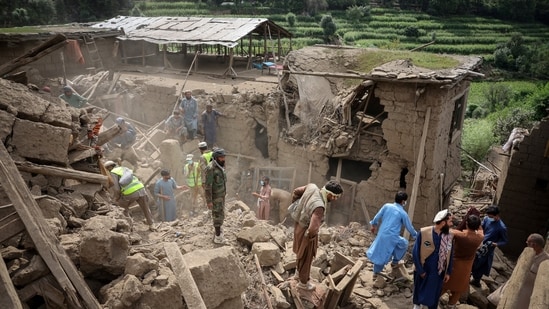
In the absence of female rescuers, many women survivors trapped under debris are not being pulled out, while the bodies of the dead are dragged out by their clothes because of prohibitions on men touching women.
Rescue efforts have been stumbling upon not only over rubble but also over gender rules in Afghanistan which is governed by the Taliban – known for imposing stringent restrictions on women – since four years.
“They gathered us in one corner and forgot about us,” a New York Times report quoted Bibi Aysha, whose village – Andarluckak in Kunar province – saw first rescue workers after over 36 hours of the earthquake ripping through eastern Afghanistan's mountainous areas on Sunday.
No one offered the women help, asked what they needed or even approached them, according to the NYT report.
Dead women out by clothes
{{/usCountry}}No one offered the women help, asked what they needed or even approached them, according to the NYT report.
Dead women out by clothes
{{/usCountry}}While emergency teams promptly pulled out injured men and children, 19-year-old Aysha and other women as well as adolescent girls were pushed aside, with some of them left bleeding.
Tahzeebullah Muhazeb, a male volunteer who traveled to Mazar Dara in the same province, said it appeared as if rescuers could not see women as members of the all-male medical team there were hesitant to rescue them from the rubble of collapsed buildings.
“It felt like women were invisible… the men and children were treated first, but the women were sitting apart, waiting for care,” the report quoted 33-year-old Muhazeb.
In the absence of male relatives, rescue workers dragged dead women out by their clothes to avoid making skin contact, he said.
While the gender breakdown of casualties from the magnitude 6 earthquake is not yet known, more than 2,200 people have died and 3,600 others have been injured, according to figures released by Afghanistan’s government.
Women in Afghanistan are deprived of basic freedoms under Taliban rule, which returned to power four years ago, promising a “revamped” version of its earlier regime that ended in 2001 after the US invasion following the September 11 attacks.
Despite claims of being less repressive than its first term, the Taliban has imposed sweeping restrictions on women, including a ban on schooling beyond the sixth grade.
Women in Afghanistan are also not allowed to travel far without a male companion and are prohibited from most jobs, including in nonprofits and humanitarian organisations, a ripple effect of which is being already seen in the current earthquake aftermath.
Afghan women working for agencies linked to the United Nations have faced harassment multiple times in the past, with threats prompting the groups to send the female female employees to temporarily work from home.
Afghanistan, scrambling to rescue survivors from Sunday's quake, is also parallelly dealing with aftershocks. On Thursday, one with a magnitude of 5.6 struck the country.