North Korean leader Kim Jong Un has changed the proportions of the national flag introduced under his grandfather, Kim Il Sung, for the first time since the country's establishment in 1948.
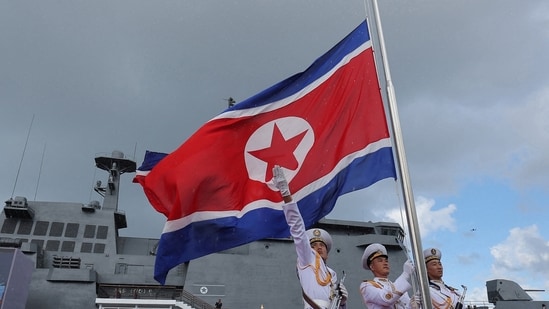
The national flag’s height-to-width ratio has been changed from 1:2 to 1:1.65, according to Article 166 of North Korea’s revised constitution, The Straits Times reported on Friday citing Naenara, a state-run website. The change makes the flag shorter while retaining its familiar design.
The revision is the first alteration to the flag's official proportions in 78 years. The flag was originally introduced under his grandfather, North Korea’s founder Kim Il Sung, with Soviet influence in the aftermath of the second World War.
Its central red field, white and blue stripes, and red five-pointed star remain unchanged. The shorter design, though, brings the red star closer to the centre of the flag.
History of North Korea's national flag
North Korea adopted its current national flag in September 1948, shortly before the formal establishment of the Democratic People's Republic of Korea on September 9, that year.
{{/usCountry}}North Korea adopted its current national flag in September 1948, shortly before the formal establishment of the Democratic People's Republic of Korea on September 9, that year.
{{/usCountry}}The design emerged during the period following World War II, when the Korean Peninsula was divided into Soviet and American occupation zones. The Soviet Union played an important role in shaping the early political and institutional structures of the North Korean state, as per the Korea Joong Ang Daily.
It featured a broad red central band, bordered by narrow white stripes and blue bands at the top and bottom. A red five-pointed star sits inside a white circle near the flagpole.
North Korean officials discussed making the flag shorter when it was first introduced in 1948. The proposed change was rejected, and the original proportions remained in place for decades, the Wall Street Journal reported.
What do the colours and symbols on the flag represent?
According to North Korea’s official interpretation, the red field represents the blood shed by revolutionary fighters during the struggle against Japanese occupation. Fyodor Tertitskiy, a Korea University lecturer who has researched the flag's history, also documented its Soviet origins, the WSJ reported.
The white circle and stripes represent loyalty to the ruling Workers' Party of Korea and the country's leader. The blue stripes symbolise anti-imperialist independence, world peace, friendship and national sovereignty.
Kim Jong Un's push to establish a separate North Korean identity
In recent years, Kim has increasingly sought to establish his own political identity through changes to state policies, national symbols and official messaging.
In late 2023, Kim abandoned the long-standing policy of peaceful reunification and began pushing for the two Koreas to be treated as separate and hostile states. In January 2024, he called for constitutional changes to reflect this.
North Korea also changed its national anthem
North Korea's national anthem also saw some changes in 2024. The country's leadership changed the lyrics of its anthem, replacing the word 'samcholli', which literally means '3,000 ri', with 'i sesang', meaning 'this world'.
The term 'samcholli' is a traditional Korean expression referring to the geographical extent of the Korean homeland. It has historically represented the entire Korean Peninsula, including both North and South Korea.