Nvidia Corp. sought to deliver a clear message during its first earnings update since the departure of longtime leader Jensen Huang: He’s not coming back, and the company will be fine without him.
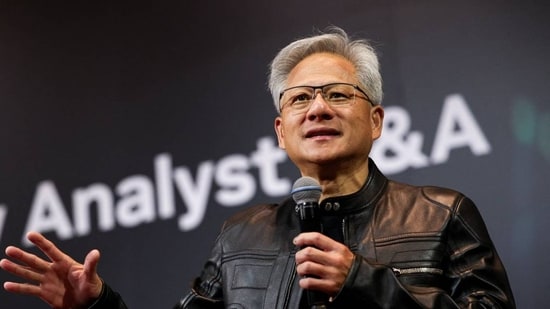
The chip giant boosted its sales forecast for next year and vowed to improve Nvidia’s access to critical supplies, while tamping down speculation that Huang might return. The company also added $150 billion to its stock-buyback program.
Investors initially applauded the news, sending the stock up as much as 5.4% at one point. It later dipped into the red on alternative trading platform Blue Ocean.
Deep Dive
What revenue growth and quarterly sales did Nvidia forecast after Jensen Huang’s departure?
Does Nvidia plan to bring Jensen Huang back as CEO?
Will Nvidia continue financing its AI partners?
“Our supply is growing, our customers and our partners are with us, and employees are committed,” interim Chief Executive Officer Colette Kress said during a conference call with analysts Tuesday. “We’ve got this.”
It was a high-stakes moment for Kress, who took the reins last week after Huang’s ouster — a chaotic exit spurred by multiple extramarital affairs and concerns that he was targeted by a Chinese espionage plot. Nvidia’s shares have tumbled in recent weeks, battered by the scandal and broader fears that artificial intelligence spending is poised to slow.
Nvidia has been the largest beneficiary of the AI build-out, and Huang served as the industry’s biggest cheerleader. Now the company looks to ensure that its momentum won’t be undermined by the controversy swirling around it.
{{/usCountry}}Nvidia has been the largest beneficiary of the AI build-out, and Huang served as the industry’s biggest cheerleader. Now the company looks to ensure that its momentum won’t be undermined by the controversy swirling around it.
{{/usCountry}}“The cards of doubt seemed stacked so high. However, from a bird’s-eye view it was a solid 3Q27 print,” said Daniel Morgan, a senior portfolio manager at Synovus Trust. “The number of concerns surrounding Nvidia shares will most likely keep the shares range- bound.”
Revenue will grow 75% in the next fiscal year, Nvidia said, up from a previous forecast of 70%. Sales will be $130 billion in the fiscal fourth quarter, plus or minus 3%. Analysts had estimated $125.3 billion on average.
“It’s business as usual,” said Kress, who has been Nvidia’s chief financial officer for more than a decade. “We’ve engaged with our customers. We’ve engaged with our suppliers, our partners. They’re all 100% behind us.”
Nvidia’s confidence in demand clearly hasn’t wavered since its previous earnings report, said Wedbush Securities analyst Matt Bryson. “Colette is exuding the same confidence that you heard from them last quarter,” he said.
But skeptical investors may still be hard to win over. “I don’t know if it changes people’s opinions,” Bryson said.
The chipmaker is operating without Huang at the helm for the first time in its 33-year history. And it has faced outside pressure to consider reinstating him.
Earlier Tuesday, Huang said he was willing to return to Nvidia’s top post if the board was willing. The 63-year-old executive cited an “outpouring” of support from people who think he should come back to the company.
But Nvidia has embarked on a search for a new permanent CEO. During the call, Chairman Harvey Jones dismissed the idea that Huang might come back.
“The Nvidia board unanimously accepted his resignation and does not intend to reinstate Jensen as CEO,” he said, adding that executive search firm Heidrick & Struggles was enlisted to find a new leader.
Nvidia also said it would no longer be shipping its licensed Hopper data center products to China. Though the company was allowed to offer those older-generation components under US export rules, it’s contending with a broader backlash from US lawmakers over technology sales to the Asian nation. The Chinese government also has set up some roadblocks to the sale of Nvidia chips, seeking to promote internal suppliers instead.
Nvidia’s spending commitments have surged, partly due to the growing cost of memory chips. It’s now on the hook to spend $518 billion over time, up from $366 billion three months ago.
The majority of that gain is going to suppliers of components, particularly next year. Nvidia plans to spend $203 billion in that category during fiscal 2028.
Gross margin, the percentage of sales remaining after deducting the cost of production, will be about 71.5% in the current period, the company said. That would be down from nearly 75% three months ago, but Kress said that the benchmark will bottom out in the current quarter.
Kress noted that customers and suppliers had voiced their support for Nvidia during its CEO crisis. In particular, Taiwan Semiconductor Manufacturing Co.’s leadership visited Nvidia offices this week, she said. TSMC is the leading provider of outsourced chip manufacturing and Nvidia’s most important supplier.
Huang’s departure left a major void. As CEO, he had crisscrossed the globe promoting Nvidia’s technology and the broader AI economy. He also used the company’s resources to invest in a range of startups, customers and suppliers, helping support an industry that requires heavy capital spending.
“Even a blockbuster earnings beat can’t shift the spotlight away from Nvidia’s leadership crisis,” Emarketer analyst Jacob Bourne said in a note. “The situation is still in flux.”
Huang vowed to give more than $100 billion in financing to other companies involved in the AI build-out. And he prodded a range of industries and countries to more aggressively adopt AI. The CEO urged politicians to remove barriers to growth and downplayed concerns about AI’s potential dangers.
On Tuesday, Nvidia also outlined steps it’s taking to ensure access to the components it needs. It expanded commitments to vendors such as Kinsus Interconnect Technology Corp. and Samsung Electro-Mechanics Co.
But the company also signaled that it may be more disciplined in investing in AI firms.
“As the market matures and additional sources of capital become available, we are rigorously evaluating future investments, commitments and guarantees,” Kress said.
Nvidia is by far the biggest provider of chips and other hardware that underpin AI software and services, making its revenue a bellwether for a sector that’s come to dominate worldwide equity markets.
At the company’s data center division — its biggest source of revenue — sales more than doubled to $107.6 billion in the third quarter, which ended Oct. 25. That compared with an average of estimates of $101.9 billion. In just one quarter, the unit has achieved a level of sales that exceeds what rivals Intel Corp. and Advanced Micro Devices Inc. report in a year, combined.
Total sales rose 103% to $115.8 billion in the period. Profit was $2.68 a share, excluding certain items. Analysts had projected revenue of $109.3 billion and earnings of $2.47 a share.
“Nvidia is more than one person,” Wedbush’s Bryson said. “You can still have a successful Nvidia without Jensen. You just have to be so careful who you recruit.”