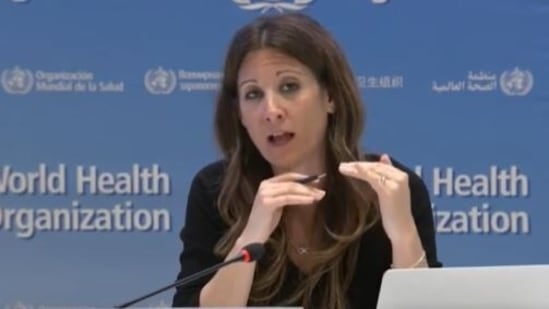
With China, South Korea seeing a fresh outbreak of Covid cases and Israel detecting a new variant of the SARS-CoV-2 virus, the World Health Organization on Saturday said misinformation about the pandemic is creating confusion among people. Omicron is mild, the pandemic is over, and this is the last variant -- all these are misinformation, WHO's Covid-19 technical lead Maria Van Kerkhove said.
Here are the 5 latest points WHO has emphasised:
1. Pandemic not over: "We have huge amounts of misinformation that's out there. The misinformation that Omicron is mild. Misinformation that the pandemic is over. Misinformation that this is the last variant that we will have to deal with. This is really causing a lot of confusion," Maria said.
2. Is BA.2 more dangerous than BA.1? On Omicron's substrain BA.1 and BA.1, Maria Van Kerkhove said experts have not yet seen changes in the severity of BA.2 compared to BA.1 at population levels. "However, with huge numbers of cases, you will see an increase in hospitalisations and that in turn has translated into increased deaths, primarily in people not vaxxed or partially vaxxed," Dr Maria said adding that countries which are seeing a huge number of mortalities than previous waves are those which have not vaxxed its people, especially the vulnerable group of people.
{{/usCountry}}2. Is BA.2 more dangerous than BA.1? On Omicron's substrain BA.1 and BA.1, Maria Van Kerkhove said experts have not yet seen changes in the severity of BA.2 compared to BA.1 at population levels. "However, with huge numbers of cases, you will see an increase in hospitalisations and that in turn has translated into increased deaths, primarily in people not vaxxed or partially vaxxed," Dr Maria said adding that countries which are seeing a huge number of mortalities than previous waves are those which have not vaxxed its people, especially the vulnerable group of people.
{{/usCountry}}3. Omicron will rest until it finds a new pocket: Variants are Omicron Executive director of WHO's health emergencies programme, Dr Mike Ryan, said Omicron will pick up pockets for months and months until another pocket of susceptibility opens up. "This is how virus work. They establish themselves within a community & move quickly to the next unprotected community," Dr Ryan said. The virus is not showing any sign of becoming seasonal as yet, he said.
4. Variants are evolution of viruses: As Israel has reported a new variant which combines Omicron's two sub-strains BA.1 and BA.2, Dr Muke Ryan said, "When a virus enters human body, it evolves. It's just evolution in action. The same virus, going into a body and coming out slightly different. That's called drift and over time that can generate variants. Recombination occurs when two viruses infect the same person or the same animal. And what you then have is not just errors in transcription. But two viruses can exchange large amount of genetic information and you effectively get a new virus out the other end."
5. Recombinants are mostly not viable: Dr Ryan said these recombinants are mostly not very good but just occassionally they are. "And that's how we generate pandemics of influenza. It's through viral recomibation which is called antigenic shift versus antigenic drift," he said adding that recombinations are to be watched closely.