
Prime Minister Narendra Modi on Friday put forward a five-point approach to address common challenges facing the world, including protectionism, unilateralism at global financial organisations like the WTO and terrorism.
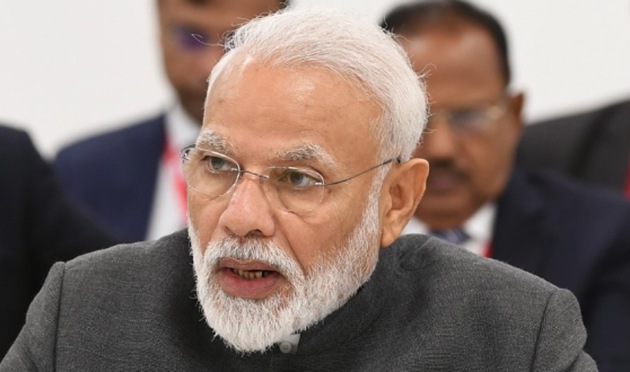
Speaking at the informal BRICS leaders’ meeting in Osaka, Modi said that there was an immediate need to strengthen the WTO, fighting protectionism, ensuring energy security and work together to fight terrorism.
Suggested For You
“Today I will focus on three major challenges. First, the recession and uncertainty in the world economy. Unilateral decisions and rivalries are overshadowing rule-based multilateral international trade systems,” Modi said.
“On the other hand, the lack of resources is reflected in the fact that there is a shortage of an estimated USD 1.3 trillion in investment for emerging market economies,” he said. He said making development and progress inclusive and sustainable is the second major challenge.
“Rapidly changing technologies such as digitisation and climate change are concerns not just for us, but also for the future generations. Development is in the right direction when it reduces inequality and contributes to empowerment,” the prime minister said. Terror is the biggest threat to all humanity, he said.
“It not only takes the lives of innocent people, but also has a negative effect on economic progress and social stability,” Modi said.
{{/usCountry}}“It not only takes the lives of innocent people, but also has a negative effect on economic progress and social stability,” Modi said.
{{/usCountry}}“There is a need to stop all the mediums of support to terrorism and racism,” Modi said.
Also read: India to raise issue of fugitives at G20
Talking about his five-point approach to tackle these challenges, Modi said the ill effects of unilateral decisions can be addressed to an extent by the coordination between the BRICS countries. “We need to emphasise on the necessary reforms in international financial and business institutions and organisations for improving multilateralism,” he said. Energy resources like oil and gas should be available at low prices regularly for continuous economic development, the prime minister said.
For sustainable and inclusive development, the New Development Bank should give priority to the investment in the physical and social infrastructure and renewable energy programmes of member countries.
The New Development Bank is a multilateral development bank established by the BRICS states -- Brazil, Russia, India, China and South Africa.
India’s initiative for Coalition for Disaster Resilient Infrastructure will help in the development of appropriate infrastructure in developed and developing countries to face natural calamities, Modi said.
“I invite you to join this coalition,” he said.
“The movement of skilled workers around the world should be made easy. This will also benefit the countries where a large part of the population has crossed the working age,” Modi said.
For fighting terrorism, the prime minister called for organising a global conference on terrorism.
“I have recently called for organising a Global Conference on Terrorism. Lack of necessary consent to fight against terrorism can not keep us inactive,” he said.
Read the live updates of the G20 summit here
Explore More
ABOUT THE AUTHOR
Follow the latest breaking news, major developments and agenda-setting stories from India and around the world with the newsdesk at Hindustan Times. Operating round the clock, the desk brings together experienced editors, reporters and correspondents to deliver fast, accurate and contextual reporting across subjects that influence public policy, governance, business, society and international affairs. The HT News Desk covers politics, elections, government policies, the economy, business and markets, science and technology, the environment, law and order, infrastructure, education, climate issues and geopolitics, while closely tracking developments across states, institutions and global capitals. The team also leads coverage of major breaking news events, policy announcements, court proceedings, natural disasters, public emergencies and significant international developments. Reports published by the newsdesk are based on information gathered from reporters on the ground, official statements, government agencies, court records, regulatory filings, recognised institutions and other authoritative sources. Stories undergo editorial scrutiny and verification processes to ensure accuracy, fairness and relevance, and are updated as events evolve and additional information becomes available. Whether covering a key political decision in New Delhi, an economic policy shift affecting millions, a landmark court ruling or a major global event, the HT News Desk aims to provide readers with reliable, fact-based journalism that delivers not only the latest developments but also the context and analysis needed to understand their wider implications.