Australian Prime Minister Anthony Albanese has selected his home-town Sidney for hosting the QUAD summit mid-2023 even as Japan has expressed serious concerns this week to China and Russia over joint air patrols over Sea of Japan and scrambled fighters in response.
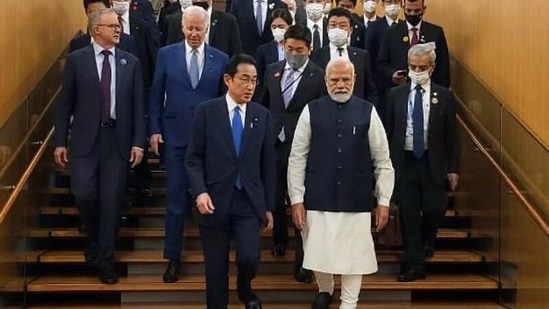
While the dates of the QUAD summit are still to be worked out, US President Joe Biden, Prime Minister Narendra Modi and Japan Prime Minister Fumio Kishida will travel to Sydney to further cement cooperation and push back the Chinese belligerence in Indo-Pacific and aggressive behavior against all four democratic countries. But before that India will be hosting the QUAD foreign ministers' meet in New Delhi as dates are being worked out.
While China has characterized QUAD as an Indo-Pacific NATO aimed primarily aimed against Beijing, fact is that it the wolf warriors of the Xi Jinping regime who are pushing the democratic nations to come together by their aggressive actions and statements. It is only due to this increased military friction from the PLA that Japan has decided to increase its defence budget from one to two percent of the GDP and Australia has become part of the AUKUS alliance to check the superpower ambitions of China.
While US faces corporate espionage and cyber-attacks from Chinese MSS agency, India is locked in a military face-off with China all along the Line of Actual Control (LAC), particularly in East Ladakh and in the eastern sector. Beijing’s uncalled for objections to India-US high altitude warfare exercise in Uttarakhand has added to the irritation of both New Delhi and Washington.
{{/usCountry}}While US faces corporate espionage and cyber-attacks from Chinese MSS agency, India is locked in a military face-off with China all along the Line of Actual Control (LAC), particularly in East Ladakh and in the eastern sector. Beijing’s uncalled for objections to India-US high altitude warfare exercise in Uttarakhand has added to the irritation of both New Delhi and Washington.
{{/usCountry}}While QUAD has become the core of Indo-Pacific push-back, countries like France, UAE, South Korea, Philippines, and Indonesia are also joining hands with countries like US and India to forge tri-lateral alliances to fend off against Chinese aggression in the Indo-Pacific and the fall-out of Russia’s Ukraine war.
Even though Japanese PM Kishida represents Hiroshima in the house of representatives and believes in nuclear pacifism, the Chinese military belligerence against Taiwan and Japan over Senkaku Islands has forced Tokyo to beef up its military with advanced missiles, armed drones and aerial platforms. That Japan has stood up to both Russia and China over joint air patrolling on Thursday is itself indicative of Tokyo’s pushback. One may recall that China and Russia flew six strategic bombers over waters near Japan on May 24, 2022, as a protest against the QUAD summit held the same day in Tokyo.
Quad which essentially started as a security grouping has now actually diversified into other areas with partners coming on the same page on trade, economic and health issues. India and Australia now have a free trade agreement and the security ties between the two countries have strengthened as never before. India and US are working towards an FTA and economic partner Japan is pushing for investment to set up industry in India as alternative supply chain. China by its belligerent actions and middle-kingdom mindset has actually become a driving force behind QUAD.