
Last month Russian military officers flew from St. Petersburg to the country’s Kaliningrad exclave nestled between two NATO countries and the Baltic Sea. There the officers oversaw readiness planning and procedures for a mobilization of the region’s residents, with details on how to house, feed and arm them, said Western intelligence officials.
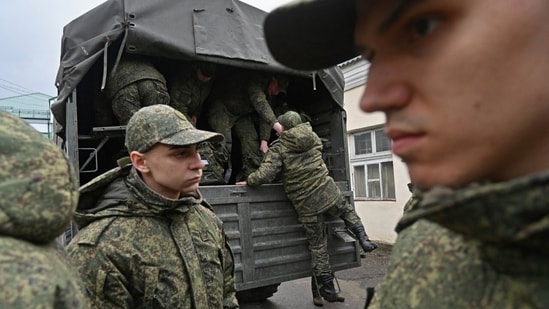
The planning exercise in Kaliningrad is just one of many being carried out nationwide, said the officials, in case the call is made.
The Kremlin hasn’t yet made
Last month Russian military officers flew from St. Petersburg to the country’s Kaliningrad exclave nestled between two NATO countries and the Baltic Sea. There the officers oversaw readiness planning and procedures for a mobilization of the region’s residents, with details on how to house, feed and arm them, said Western intelligence officials.
The planning exercise in Kaliningrad is just one of many being carried out nationwide, said the officials, in case the call is made.
The Kremlin hasn’t yet made a decision to follow through on any such move, those officials say, and likely won’t until after parliamentary elections in late September. But Russian leader Vladimir Putin’s determination to take all of eastern Ukraine’s Donbas region, despite tiny and costly advances, may force his hand.
In recent months, Moscow has failed to recruit enough new soldiers to make up for those killed and injured on the battlefield, while Ukrainian drone advances have reduced the average Russian soldier’s lifespan on the front to a matter of minutes, days or weeks. Those problems in manpower may leave Putin with no choice other than to order a fresh wave of mobilization not seen in years, U.S. and European officials said.
Neither the Kremlin nor the Russian Defense Ministry responded to requests for comment.
Kaliningrad, the site of the mobilization test exercise last month, has come under increased scrutiny recently as Western intelligence officials have warned that it could potentially play a role in Moscow’s military planning. Russia, they say, in a potential escalation with the West could seize part of the adjacent Suwalki Gap, a strip of land that runs from Kaliningrad to Belarus, Russia’s ally, through neighboring Poland and Lithuania.
Russia has long seen Kaliningrad’s geographic location and tiny population as a vulnerability as well as a useful foothold in Europe. Captured by the Soviet Union from Germany in 1945, it long served as Russia’s only ice-free port on the Baltic. Moscow has at times carried out outsize military exercises there as a deterrent to the North Atlantic Treaty Organization. Allied countries have also responded and in the past week carried out a planned air exercise near the Russian exclave, using U.S. and Norwegian fighter aircraft and Polish ground forces.
Putin’s last mobilization, called in September 2022 to stabilize Moscow’s buckling front line, triggered chaos across the country. Hundreds of thousands of men left Russia, leading to a rush on airline tickets and hourslong lines to cross the border into neighboring countries such as Georgia and Kazakhstan.
Now, rumors of an impending mobilization in recent weeks and months have caused jitters inside Russia, with men looking online for ways to exit the country in a pinch. Some Russians who have the money to travel have already scoped out destinations for the next few months where they can wait out a potential mobilization.
Moscow’s Customs Service said last week that the flow of traffic between Russia and Georgia at the Verkhny Lars border checkpoint, which sits on an old Russian imperial military road, had broken a record with more than 20,000 people crossing in one day. Georgia’s Interior Ministry disputed those figures.
Property prices have also gone up in recent weeks in places like Georgia and Armenia, partly in anticipation of another wave of Russian emigrants, say real-estate agents in both countries.
A call to mobilize could help buttress the Russian front line and accelerate Putin’s advance on Kramatorsk and Sloviansk, the last two major Ukrainian-controlled cities in Donbas. But should it be carried out so late in the year before winter slows fighting, it’s unclear what effect the move may have in practical terms.
“I don’t think it’ll prove decisive for Russia and it’s actually too late this year, but it could be a factor for 2027,” said Michael Kofman, senior fellow at the Carnegie Endowment think tank in Washington. “If they have concrete timetables for objectives they want to accomplish this year, like seizing the rest of the Donbas, then they should have mobilized several months ago.”
Most Russians publicly support the war, and any mass mobilization is unlikely to be met with meaningful unrest. Nonetheless, enthusiasm for it has waned in recent months, according to Russian polling agencies, causing new political strains inside the country.
A mass mobilization would also put an enormous financial burden on Russia’s already fragile economy.
“Russia would be further mortgaging its future for the sake of military gains,” said Alexander Kolyandr, a director at the consulting firm Eurasia Group. “You need to feed, house, arm, and pay these people, and you take them off the already tight labor market. This would put the budget under immense pressure.”
Russia’s recruitment is still officially voluntary, though authorities are increasingly using strong-arm tactics, manipulation and even violence to boost numbers at the front. But changes in the way Russia keeps data on its citizens may give the Kremlin the tools to mobilize men more gradually and forgo moves that would trigger mass panic.
Over the past several years, Russia has compiled a database of all men of military age eligible to serve, and has started alerting those who have to appear at the recruitment office. Russian authorities could boost those alerts to men across the country, raising the number in stages.
“It’s easier for them to cook the frog slowly, calling people up in small numbers,” said Alexey Yusupov, Russian analyst at the Friedrich Ebert Foundation, a German political think tank tied to the Social Democratic Party. “There would be nothing compared to 2022.”
“Since the last mobilization, the Kremlin has tried to convince Russians that it is waging this war responsibly,” he said. “Upending that sentiment would be dangerous.”
Write to Thomas Grove at thomas.grove@wsj.com and Alexander Ward at alex.ward@wsj.com
One Subscription.
Get 360° coverage—from daily headlines
to 100 year archives.
Archives
HT App & Website