A concrete-like material, but stronger than ordinary concrete, has been created by the scientists at the University of Manchester, which they claim, has been made out of extra-terrestrial dust along with the blood, sweat and tears of astronauts.
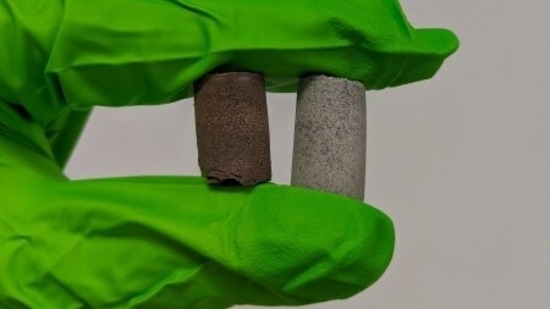
According to a study published in the journal Materials Today Bio, “a protein from human blood, combined with a compound from urine, sweat or tears, could glue together simulated moon or Mars soil to produce a material stronger than ordinary concrete, perfectly suited for construction work in extra-terrestrial environments,” the university said in a statement.
Further, the scientists also claimed that the cost of transporting a single brick to Mars would be $2 million and therefore future Martian colonists would have to use the resources they can obtain from that planet for construction rather than bringing their own. “This is known as in-situ resource utilisation (or ISRU) and typically focuses on the use of loose rock and Martian soil (known as regolith) and sparse water deposits,” the statement read.
The scientists demonstrated that the human serum albumin, a common protein from blood plasma, could act as a binder for simulated moon or Mars dust to produce a concrete-like material named AstroCrete. It is found to have compressive strengths as high as 25Mpa (megapascals) similar to that of ordinary concrete (20Mpa to 32 MPa).
{{/usCountry}}The scientists demonstrated that the human serum albumin, a common protein from blood plasma, could act as a binder for simulated moon or Mars dust to produce a concrete-like material named AstroCrete. It is found to have compressive strengths as high as 25Mpa (megapascals) similar to that of ordinary concrete (20Mpa to 32 MPa).
{{/usCountry}}However, the scientists have also found that by incorporating urea, the compressive strength could further be increased by over 300% with the best performing material having a compressive strength of almost 40 MPa, substantially stronger than ordinary concrete. Urea is a biological waste product that the body produces and excretes through urine, sweat and tears.
The new technique holds considerable advantages over many other proposed construction techniques in the moon and Mars, said Dr Aled Roberts from the University of Manchester who worked on the project. “Scientists have been trying to develop viable technologies to produce concrete-like materials on the surface of Mars, but we never stopped to think that the answer might be inside us all along,” he said.
Over 500 kg of AstroCrete could be produced over the course of a two-year mission on the surface of Mars by a crew of six astronauts, the scientists calculated. “If used as a mortar for sandbags or heat-fused regolith bricks, each crew member could produce enough AstroCrete to expand the habitat to support an additional crew member, doubling the housing available with each successive mission,” the statement said.