South Korea's Parliament on Tuesday passed a bill to prohibit the consumption and sale of dog meat, marking the end of a centuries-old practice. The move reflects a shift in societal attitudes towards animal welfare, with an increasing number of Koreans viewing dogs as family members.
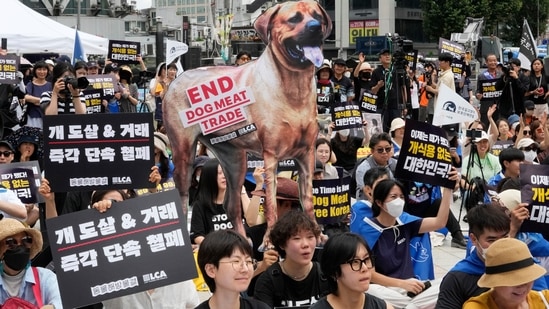
Traditionally perceived as a means to boost stamina during the humid Korean summer, the consumption of dog meat has dwindled over time, with the practice now primarily associated with older people. Criticism of the methods used in slaughtering dogs, such as electrocution or hanging, has contributed to the decline in the practice.
The legislation reads, “This law is aimed at contributing to realizing the values of animal rights, which pursue respect for life and a harmonious co-existence between humans and animals.”
Traders have pointed out that progress has been made in adopting more humane slaughtering practices.
The bill, proposed by the ruling party, received overwhelming support in the single-chamber parliament, garnering 208 votes with two abstentions after approval by the bipartisan agriculture committee on Monday.
President Yoon Suk Yeol, known for his love of animals and having adopted six dogs and eight cats with First Lady Kim Keon Hee, who is also a vocal critic of dog meat consumption, has led to growing support for the ban.
{{/usCountry}}President Yoon Suk Yeol, known for his love of animals and having adopted six dogs and eight cats with First Lady Kim Keon Hee, who is also a vocal critic of dog meat consumption, has led to growing support for the ban.
{{/usCountry}}The legislation is set to take effect after a three-year grace period, and violations could result in up to three years in prison or fines of 30 million won ($22,800).
Animal protection group Humane Society International (HSI) Korea's Borami Seo told Reuters, “The bill would see an end to the breeding and killing of dogs for human consumption. We have reached a pivotal point to spare millions of dogs from this cruel industry.”
According to a survey released on Monday by Seoul-based think tank Animal Welfare Awareness, Research and Education, over 94 per cent of respondents reported abstaining from consuming dog meat in the past year, and approximately 93 per cent expressed their intention to refrain from doing so in the future.
HSI executive director JungAh Chae told AP, “I never thought I would see in my lifetime a ban on the cruel dog meat industry in South Korea, but this historic win for animals is a testament to the passion and determination of our animal protection movement.”
Despite prior unsuccessful attempts to ban dog meat due to opposition from the industry, the current bill aims to offer compensation to facilitate the transition of businesses away from the trade.
In November, around 200 dog breeders for consumption staged a rally near the presidential office, urging the abandonment of the proposed legislation.
As of April 2022, the agriculture ministry estimated that 1,100 farms were breeding 570,000 dogs for consumption, destined for approximately 1,600 restaurants.
A farmer and leader of a farmers' association told AP, “This is a clear state violence as they’re infringing upon freedom of occupational option. We can’t just sit idly.”
The Korean Association of Edible Dogs, a coalition representing breeders and sellers, contended that the ban would impact 3,500 farms involved in raising 1.5 million dogs, along with 3,000 restaurants.