Hundreds of thousands of protesters marched across Spain on Wednesday over the country's housing affordability and purchasing power, just weeks before an early general election.
Businesses and public transportation were disrupted as workers joined the nationwide action, with thousands taking to the streets in major cities to protest soaring rents and property prices across the eurozone's fourth-largest economy.
The strike, held under the slogan “Salaries. Housing. Prices.”, was Spain's first nationwide general demonstration in 14 years and the first to be driven primarily by discontent over housing.
The walkout is backed by Spain's two largest unions, the General Union of Workers (UGT) and the Workers' Commissions (CCOO), representing more than a million workers, as well as tenants' associations angry about rising rents and evictions, Reuters reported.
Over 4,00,000 marchers gathered in Barcelona, according to housing activists. Meanwhile, the city government said 55,000 turned out to walk behind a huge banner that said “Live. Not Just Survive,” according to the Associated Press.
Spanish government officials estimated 120,000 people turned out in Madrid despite pouring rain.
{{/usCountry}}Spanish government officials estimated 120,000 people turned out in Madrid despite pouring rain.
{{/usCountry}}Shops shut, furniture set on fire
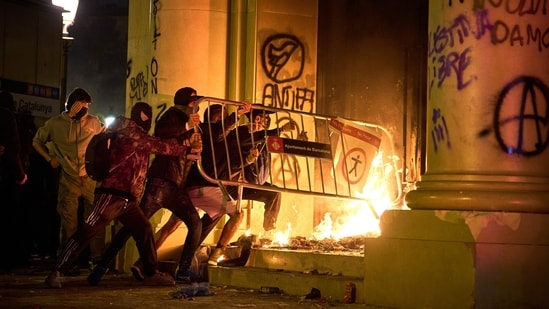
Reuters footage showed furniture set alight in the streets after the main march had ended. Tensions also escalated in Madrid, where riot police fired foam bullets and used tear gas and pepper spray to disperse protesters near the central Plaza de España, a Reuters witness said.
Police reported at least 73 arrests nationwide by 21:00 GMT, following at least 1,044 incidents linked to the general strike. These included office and industrial estate blockades, as well as the burning of rubbish containers.
On Madrid's Gran Via, one of the capital's main shopping streets, protesters cheered as stores including Primark, H&M and Pull&Bear pulled down their shutters amid a heavy police presence.
"We're going to close the Mango store," protesters chanted as they jingled sets of house keys above their heads, Reuters reported.
Many shops in Barcelona were also closed and boarded up ahead of the demonstrations amid fears of unrest. During the day, Barcelona’s metro and public buses stopped running outside rush hour.
Protesters began smashing the storefronts of major brands along Paseo de Gracia, one of Barcelona's main shopping boulevards. They set off small fires outside stores, including an Apple outlet whose entrance was shattered, burned dumpsters and launched fireworks at police officers who arrived in riot gear and armored vans, AP reported.
Protestors brave heavy rain
As evening fell in Spain's capital, the wide Paseo del Prado boulevard became a sea of umbrellas as thousands gathered in steady rain. Around 120,000 demonstrators marched through central Madrid, carrying placards shaped like houses and chanting "We have no home" as they demanded more affordable housing, according to an official estimate.
Almudena López, 74, and her husband attended Wednesday’s protest in Madrid thinking of their children.
“My son is 43 years old and still doesn’t own a home as he cannot afford one,” López said. She said her son, who works in IT, has to rent a small room in a shared apartment.
“When I was young, if you had a university degree, you could get a job by saving a bit — which always required some sacrifice — but you could manage. It’s nothing like it is today,” AP reported.
"People work a lot and it isn't enough to pay the rent, to pay for a house," Paula Diaz, a 25-year-old theatre technician who lives with her parents, told AFP at the Madrid protest.
"I hope a government that benefits us comes to power, especially the working class," she added, referring to the November 29 election.
What led to the strikes
The strike follows weeks of demonstrations provoked by the eviction and subsequent death of an 87-year-old woman in Madrid.
Maricarmen Abascal, 87, was forcibly removed on a stretcher from her apartment of more than 70 years on 23 September after she was unable to afford steep rent increases, according to BBC.
The company that owned the flat later offered to allow her to return at a lower rate - but she was unable to sign an agreement as she had been admitted to hospital.
Announcing her death, Madrid Tenants' Union said Abascal's situation marked "a turning point in the history of this country".
Spain’s housing problem
Spain faces a housing shortage of about 750,000 homes, a figure expected to rise to more than a million by 2028, according to the central bank, Reuters reported.
With fewer people able to afford a home, renting has increased sharply, putting pressure on that market. The average rental price of €1,176 ($1,315) is equivalent to about 98.7% of a young person's average monthly salary in Spain, according to the Youth Council of Spain.
Prime Minister Pedro Sanchez hopes to tap into voter anger over housing ahead of the November 29 election, shifting attention away from a deadly migration incident in Ceuta and a train crash last month. His government has defended its handling of both incidents, but his Socialist Party continues to trail in opinion polls.
(With inputs from Reuters, AP, AFP)