A little less than three years after he was sworn in as prime minister for the second time, Khadga Prasad Sharma Oli on Sunday morning dropped a bombshell on his rivals in the ruling Nepal Communist Party. PM Oli’s cabinet recommended dissolution of the 275-member House of Representatives that was elected in 2017, when the opposition Nepali Congress suffered a defeat by a landslide in the polls.
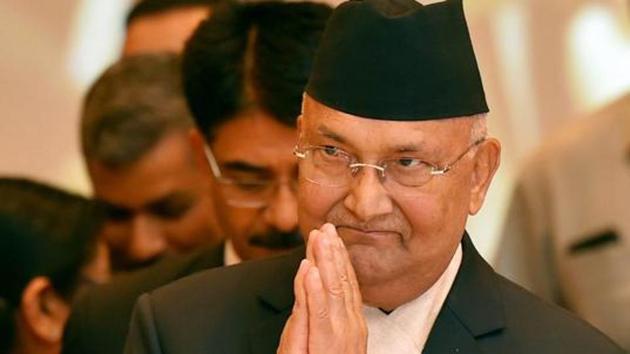
PM Oli’s surprise move on Sunday sent his rivals within the ruling Nepal Communist Party running for cover, arguing that Nepal’s constitution did not have a provision for dissolution of Parliament by a Prime Minister at the head of a majority government.
Bishnu Rijal, a central committee member of the ruling party, said that instead of seeking a compromise with his rivals in the party, PM Oli had chosen to dissolve Parliament. “The prime minister has lost the majority in the parliamentary party, central committee and the secretariat of the party,” a Reuters report quoted him as saying.
President Bidya Devi Bhandari accepted the recommendation and announced national elections in two phases to be held on April 30 and May 10.
People familiar with the matter said PM Oli’s move to dissolve Parliament would give him a free hand to run the government and split the party formed in 2018 by the merger of his Communist Party of Nepal (Unified Marxist–Leninist) and his rival Pushpa Kamal Dahal aka Prachanda’s Communist Party of Nepal- Maoist Centre.
{{/usCountry}}People familiar with the matter said PM Oli’s move to dissolve Parliament would give him a free hand to run the government and split the party formed in 2018 by the merger of his Communist Party of Nepal (Unified Marxist–Leninist) and his rival Pushpa Kamal Dahal aka Prachanda’s Communist Party of Nepal- Maoist Centre.
{{/usCountry}}For months, Prachanda had been trying to pin PM Oli down and had led several revolts against the prime minister, demanding a greater say in running the government. PM Oli, who had led them to victory on the basis of a nationalist agenda had refused to cede any space and dropped enough hints that he was prepared to split the Nepal Communist Party if he was pushed to the wall.
This is an eventuality that the Chinese Communist Party had been struggling to avoid for months.
Beijing had deputed its envoy to Nepal Hou Yanqi to hold a series of meetings in late April and early May — around the same time that China’s soldiers were crossing the line in eastern Ladakh — to hold consultations with Nepal’s communist leaders to get them to stay united.
Ambassador Hou continued her interventions to keep the NCP united over the next few months. But PM Oli’s camp soon enough figured out that China was okay with the ruling NCP giving PM Oli the pink slip if this is what it would take to avoid a split in the party.
PM Oli, who had spent 14 years in jail for opposing the now-abolished monarchy in the 1970s and 1980s, wasn’t ready to fade into oblivion yet.
Nepal watchers said China, which initially seemed to back 68-year-old Oli, had changed tack earlier this year and was willing to sacrifice him if it would help keep the NCP united.
Ambassador Hou was working on this pitch when last month, PM Oli is believed to have told her off, suggesting that he was capable of handling challenges within his party without any assistance from other countries.
The Chinese envoy didn’t exactly back off but her subsequent interventions were done quietly. When meeting politicians from the ruling party, she would move around in unmarked cars or taxis in Kathmandu, said a Nepal watcher.
“There were two other formulas that the Chinese envoy continued to work on,” a person who tracks developments in Nepal politics said on condition of anonymity. Apart from negotiating a format where the NCP’s former prime minister Dahal and Madhav Nepal hold the strings of power minus PM Oli, ambassador Hou also explored the possibility of the NCP shunting out PM Oli and promoting Deputy Prime Minister Bamdev Gautam instead.
Since Gautam comes from the Communist Party of Nepal (Unified Marxist–Leninist) that PM Oli headed before the 2018 merger, it was expected that this would minimise the damage that PM Oli could wreak on the party in case of a split. The fourth option that the Chinese envoy did explore was the possibility that the senior leadership of the NCP let the next generation leaders of the party who would be more amenable to a negotiated settlement take charge, the Nepal watcher said.
PM Oli’s Sunday surprise, however, upended the Chinese efforts as well.
Oli aide Rajan Bhattarai said the prime minister had made the move because of the backlash against him by his party, which had also asked him to consider quitting as its president.
“So he decided to face the people in an election,” Bhattarai told Reuters. “This is the best way in a democracy.”