
Five people including a soldier were killed after gunmen stormed a luxury hotel in the southwestern Pakistani city of Gwadar, the centrepiece of a multi-billion dollar Chinese infrastructure project, the military said Sunday.
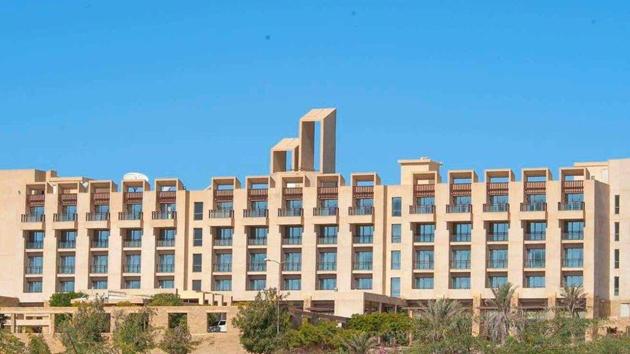
The soldier was among security forces who rushed to the five-star Pearl Continental Hotel after the attack on Saturday.
Suggested For You
During the attack “5 individuals got Shaheed (martyred) including 4 hotel employees and a Pakistan Navy soldier,” the military said in a statement. One of the hotel staff killed was a security guard shot at the entrance.
Six others were injured including four security service officers and two hotel staff members.
The military said all three terrorists had been killed. Local police had earlier claimed there had been four attackers.
A Baloch separatist group, the Balochistan Liberation Army (BLA), claimed responsibility for the attack via Twitter.
Prime minister Imran Khan said the attack was a bid to “sabotage prosperity”.
“Such attempts especially in Balochistan are an effort to sabotage our economic projects and prosperity. We shall not allow these agendas to succeed,” Khan said in a statement issued by his office.
The Chinese embassy in Islamabad also strongly condemned the incident.
{{/usCountry}}The Chinese embassy in Islamabad also strongly condemned the incident.
{{/usCountry}}- ‘The next Dubai’-
The Pearl Continental, part of Pakistan’s largest five-star hotel chain, is the only luxury hotel in Gwadar, frequented by foreign and Pakistani business delegations as well as diplomats.
It sits isolated on a ridge overlooking the Arabian Sea port city that was formerly a small fishing village, but now touted by officials as “the next Dubai” thanks to the multi-billion dollar China-Pakistan Economic Corridor (CPEC).
Part of China’s Belt and Road initiative, CPEC seeks to connect the western Chinese province of Xinjiang with Gwadar, with the development of the port as the plan’s flagship project.
Gwadar will provide China with safer and more direct access to the oil-rich Middle East than the waterway trade route it currently uses through the narrow Malacca Straits.
But it has also drawn its share of attacks -- particularly from separatists who have long complained that residents of Pakistan’s poorest and largest province do not receive a fair share of profits from its resources.
The BLA has targeted Chinese workers in Pakistan multiple times, including during a brazen daylight attack on the Chinese consulate in Karachi which killed four people in November last year.
At the time, the BLA branded Beijing “an oppressor”.
Balochistan is tightly guarded by the Pakistani military, who have been targeting insurgents there since 2004. The army has been repeatedly accused by international rights groups of abuses there, but denies all allegations.
The attack was the second deadly attack in a prominent Pakistan city this week, after a suicide blast claimed by the Pakistani Taliban at one of the country’s oldest and most popular Sufi shrines killed at least 12 people in the eastern city of Lahore.
Explore More
ABOUT THE AUTHOR
Follow the latest breaking news, major developments and agenda-setting stories from India and around the world with the newsdesk at Hindustan Times. Operating round the clock, the desk brings together experienced editors, reporters and correspondents to deliver fast, accurate and contextual reporting across subjects that influence public policy, governance, business, society and international affairs. The HT News Desk covers politics, elections, government policies, the economy, business and markets, science and technology, the environment, law and order, infrastructure, education, climate issues and geopolitics, while closely tracking developments across states, institutions and global capitals. The team also leads coverage of major breaking news events, policy announcements, court proceedings, natural disasters, public emergencies and significant international developments. Reports published by the newsdesk are based on information gathered from reporters on the ground, official statements, government agencies, court records, regulatory filings, recognised institutions and other authoritative sources. Stories undergo editorial scrutiny and verification processes to ensure accuracy, fairness and relevance, and are updated as events evolve and additional information becomes available. Whether covering a key political decision in New Delhi, an economic policy shift affecting millions, a landmark court ruling or a major global event, the HT News Desk aims to provide readers with reliable, fact-based journalism that delivers not only the latest developments but also the context and analysis needed to understand their wider implications.