
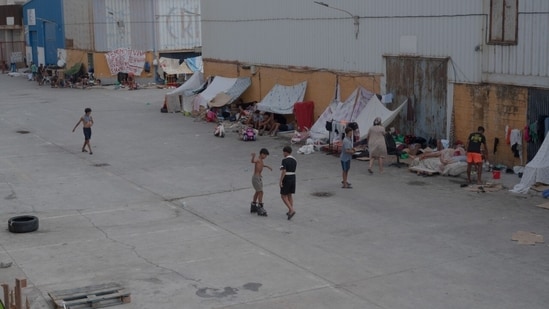
CEUTA, Spain—An abandoned warehouse complex overlooking the Moroccan border in this tiny Spanish territory has become a squalid village, with hundreds of migrants living under sheets tied to the sides of buildings and sleeping on broken-down cars and ripped sofas.
Three weeks ago, more than 72,000 migrants poured into Ceuta, overwhelming authorities and causing many residents to close up their shops and stay inside their homes. Seeing little hope of making it to continental Europe, most of the migrants left
CEUTA, Spain—An abandoned warehouse complex overlooking the Moroccan border in this tiny Spanish territory has become a squalid village, with hundreds of migrants living under sheets tied to the sides of buildings and sleeping on broken-down cars and ripped sofas.
Three weeks ago, more than 72,000 migrants poured into Ceuta, overwhelming authorities and causing many residents to close up their shops and stay inside their homes. Seeing little hope of making it to continental Europe, most of the migrants left within days. But thousands who stayed behind, refusing to leave, are creating a humanitarian crisis in the Spanish exclave—and a growing headache for local residents.
Ceuta Mayor Juan Jesus Vivas says as many as 5,000 migrants stayed—a large number compared with the territory’s population of 83,000. Makeshift migrant camps have popped up across Ceuta, one of Spain’s territories in North Africa.
Now, anger is growing among the locals in Ceuta, many of whom blame the government for not doing enough to take control and bring an end to what they see as a dangerous situation for them and the migrants. Some in the territory, which is home to a mix of Christians and Muslims, have sought to help feed and care for the mostly Moroccan migrants. Many say they no longer feel safe with groups of young migrants roaming the streets.
“I have been deprived of my human rights to freedom and security,” said Immaculada Heras Carmona, on the verge of tears. She and her friends go jogging in groups for their safety. “What is the army doing? I am not against immigration. But it’s out of control.”
The 50-year-old Heras Carmona, who works at Ceuta’s University Hospital, said emergency services there are overwhelmed and struggling to provide care for the migrants. As she spoke on the beach in the city center, three wounded migrants confirmed her claim.
One had a festering cut on his shin that he said he got from a fall on the rocks near the beach. Another had a swollen knee and was struggling to walk. He said he had called an ambulance but it had never turned up.
A community leader in Ceuta, Sabah Hamad, has been collecting donations to feed hundreds of migrants a day. She usually starts her mornings stepping around dozens of young men who sleep outside her home hoping for food or a fresh shower. “This city is sick,” she said of the conditions.
The Spanish government says it is responding to the crisis. On Monday, it said it would open space to house 1,500 migrants in a parking lot, a playing field and an equestrian center.
Elma Saiz, the minister for inclusion, social security and migration, said food and basic healthcare had been provided daily to 4,000 migrants by the Red Cross. She said the government, in conjunction with the international organization, had allocated 6.5 million euros of emergency funds to cope with the new arrivals. She also acknowledged the great work that had been done by community organizations in Ceuta to assist the migrants.
Migrants first poured into Ceuta in late July after messages circulated on social media saying the border would be open and suggesting that a recent Spanish Supreme Court ruling would make it more difficult for the government to return them. Tens of thousands scaled fences and swam around a breakwater separating Moroccan territory from Spain.
At least 90 people died in the rush into Ceuta. Videos of the border being overrun went viral and prompted France to strengthen border security. Italian Prime Minister Giorgia Meloni threatened to suspend the Schengen rules that allow for the free movement of people and goods within the European Union.
The migrants were halted in Ceuta, which is subject to special border checks as a part of the rules regulating Spain’s territories in North Africa. The Spanish government appeared to quickly get control of the situation, working with Morocco to send tens of thousands of the migrants back almost as quickly as they had arrived.
But they appear to have little answer for what to do with the thousands of migrants who have refused to go back. The migrants, in interviews, said they believe the Spanish government is simply leaving the migrants to fester in the camps in the hopes that they will give up their quest to make it to continental Europe and return home.
Many of the migrants staying in Ceuta are young Moroccans who say they faced limited opportunities for better jobs and lives in their native country. Some had jobs and were highly educated. The destitution they are now facing in Ceuta is a new experience for them, but they say the hardship is worth it for the chance at entering Europe.
Hakim Yahya, 20, said that before he came to Ceuta, he had tried unsuccessfully to join a Spanish soccer club. He said he stays below the radar by keeping a stylish haircut. “They think I am a hipster,” he said of the police.
Most of the migrants in Ceuta are Moroccan, although some are from other parts of Africa. One 16-year-old who declined to give his name said he was from the West African nation of Guinea. He had ended up in Morocco after crossing through al-Qaeda-held areas of Mali. When he saw the wave of migrants crossing in late July, he joined in.
Most of the migrants said they had no plans to leave Ceuta—unless they were headed for continental Europe. Community leaders in Ceuta said if the stalemate isn’t resolved soon, it will put the safety of both the migrants and residents here at risk.
Young women who are part of the migrant population are particularly vulnerable. Abdellah Mustafa, who runs a neighborhood association in an Arab-dominated area of Ceuta, has set up a small camp for women, protected by 5-meter-high barriers. He said he has heard several accounts from migrants of alleged sexual assaults.
Hamad, the community leader, says she is reaching a breaking point. “It breaks your heart when you see a person who has been waiting for two hours, and you have nothing to offer,” she said. “We can’t go on like this. Moroccans, they have to get out.”
Write to Benoit Faucon at benoit.faucon@wsj.com
One Subscription.
Get 360° coverage—from daily headlines
to 100 year archives.
Archives
HT App & Website